

6 insights from the 2026 Arccos driving distance report
News

6 insights from the 2026 Arccos driving distance report

Support our Mission. We independently test each product we recommend. When you buy through our links, we may earn a commission.

6 insights from the 2026 Arccos driving distance report

Every year, like clockwork, golf’s powers-that-be remind us that the average golfer is hitting the ball too far. It’s gotta be the ball. Or some such nonsense.

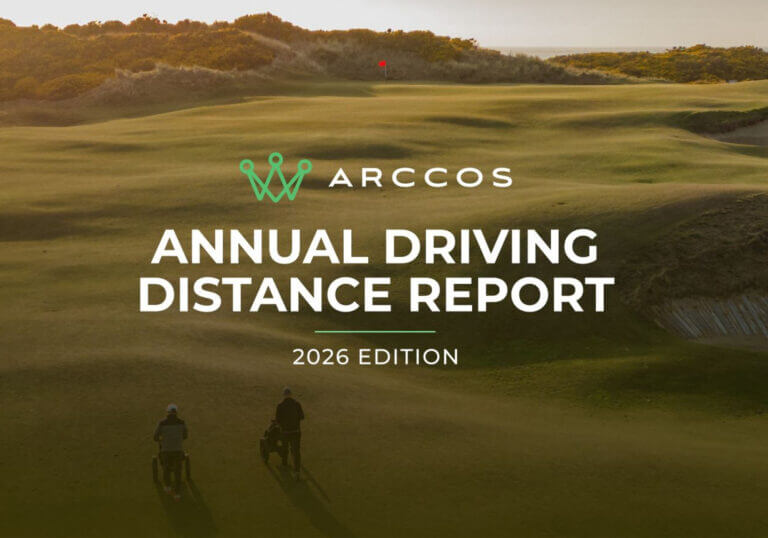
For the eighth consecutive year, Arccos is offering up a different kind of evidence—actual on-course shots from real golfers playing real rounds. And for the eighth consecutive year, the data tells the same story.

The average amateur isn’t hitting it any farther than he did in 2018. Women are actually hitting it shorter.
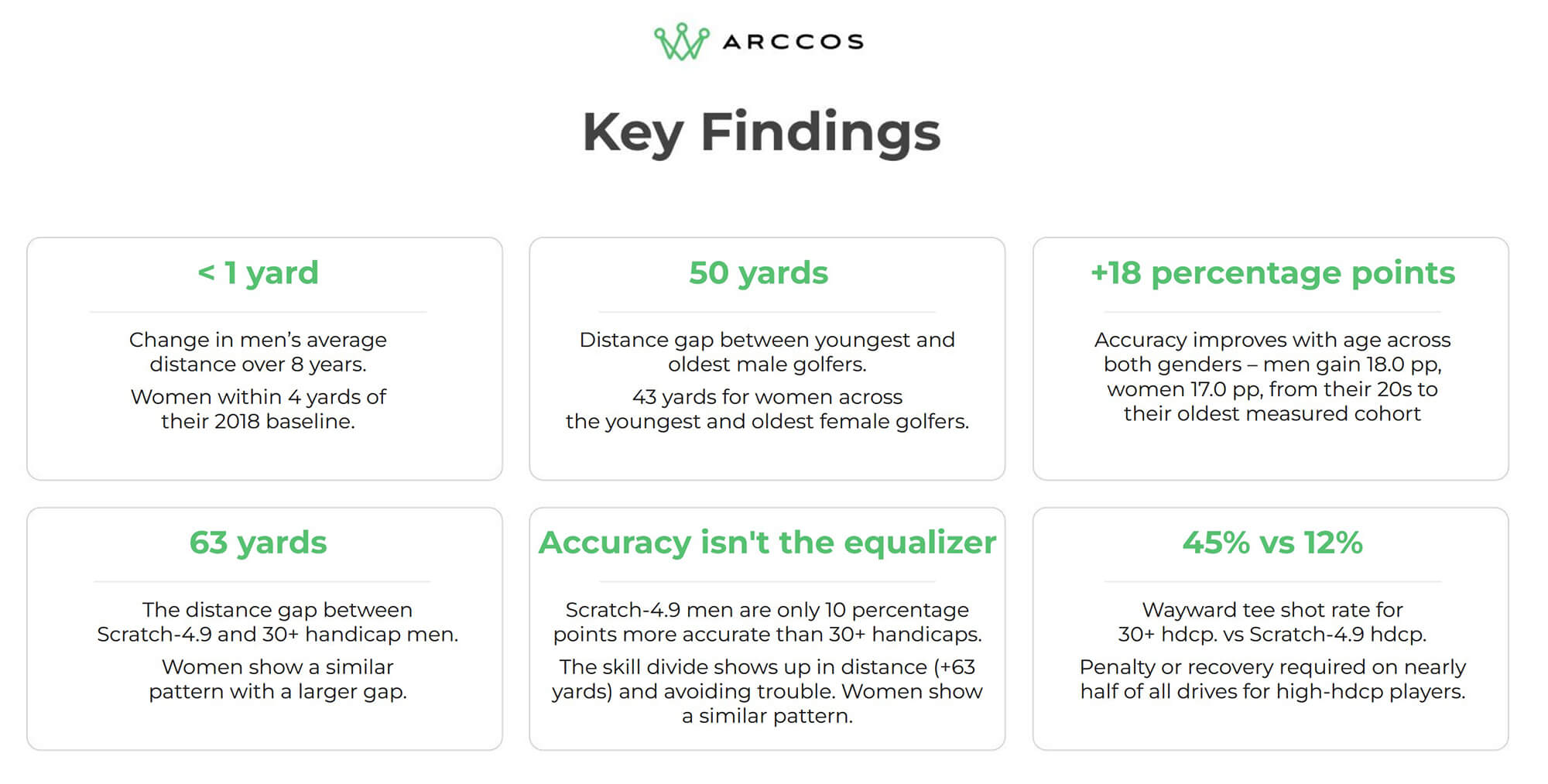
2026 Arccos Distance Insights Key findings

About the 2026 Arccos driving distance report

The 2026 edition (download the full report here) draws on more than five million rounds and nearly 10 million driver tee shots recorded during the 2025 calendar year. Total yardage (carry plus rollout) on par 4s and par 5s, sliced by age, handicap and gender. If you want a clear-eyed look at how amateurs actually hit it off the tee, this is about as robust a dataset as you’re going to find anywhere.

With that, here are the six insights I found most interesting.

The average amateur isn’t getting any longer
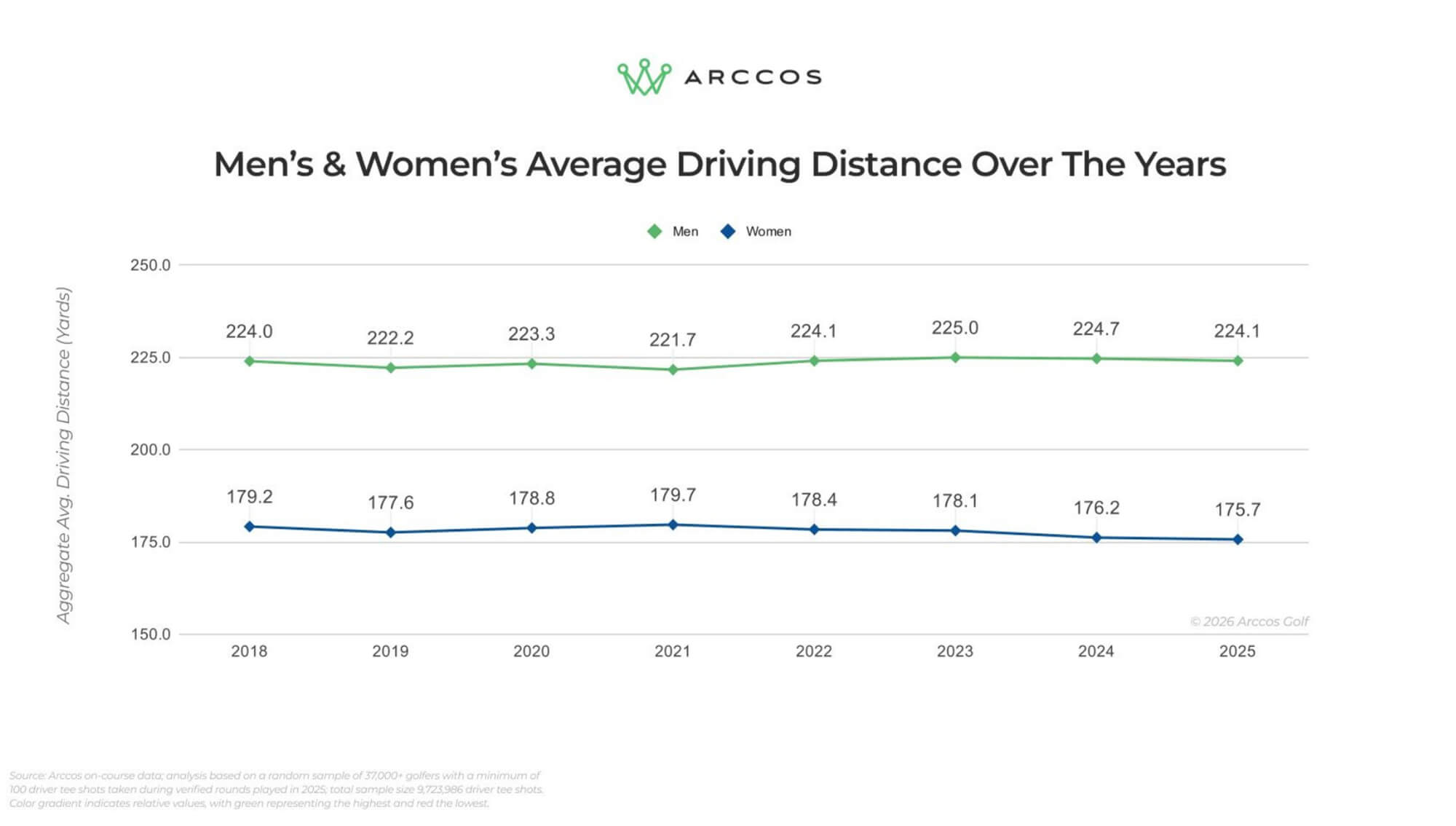
In 2018, the average male Arccos user hit driver 224.0 yards. In 2025, that number is 224.1.

#BOMBS

If you’re scoring at home, that’s a tenth of a yard of “progress” over eight calendar years. Twist faces, AI heads, faster balls, better shafts. None of it has moved the needle for the average weekend hacker. Not by a yard. Not by a half. Arguably, not at all.

Remind me again why we’re rolling back the golf ball?

Women are actually losing distance

Here’s the part that’s often overlooked. Over the same eight-year window (see above), the women’s average has dropped from 179.2 yards to 175.7. A loss of three and a half yards.

The report doesn’t unpack why, but given how steeply distance falls with age (more on that in a second), it’s reasonable to wonder whether the women’s user base has gradually shifted older. Whatever the explanation, it’s hard to look at the trend line and conclude that anything resembling a distance crisis exists in amateur women’s golf.

The knife cuts both ways
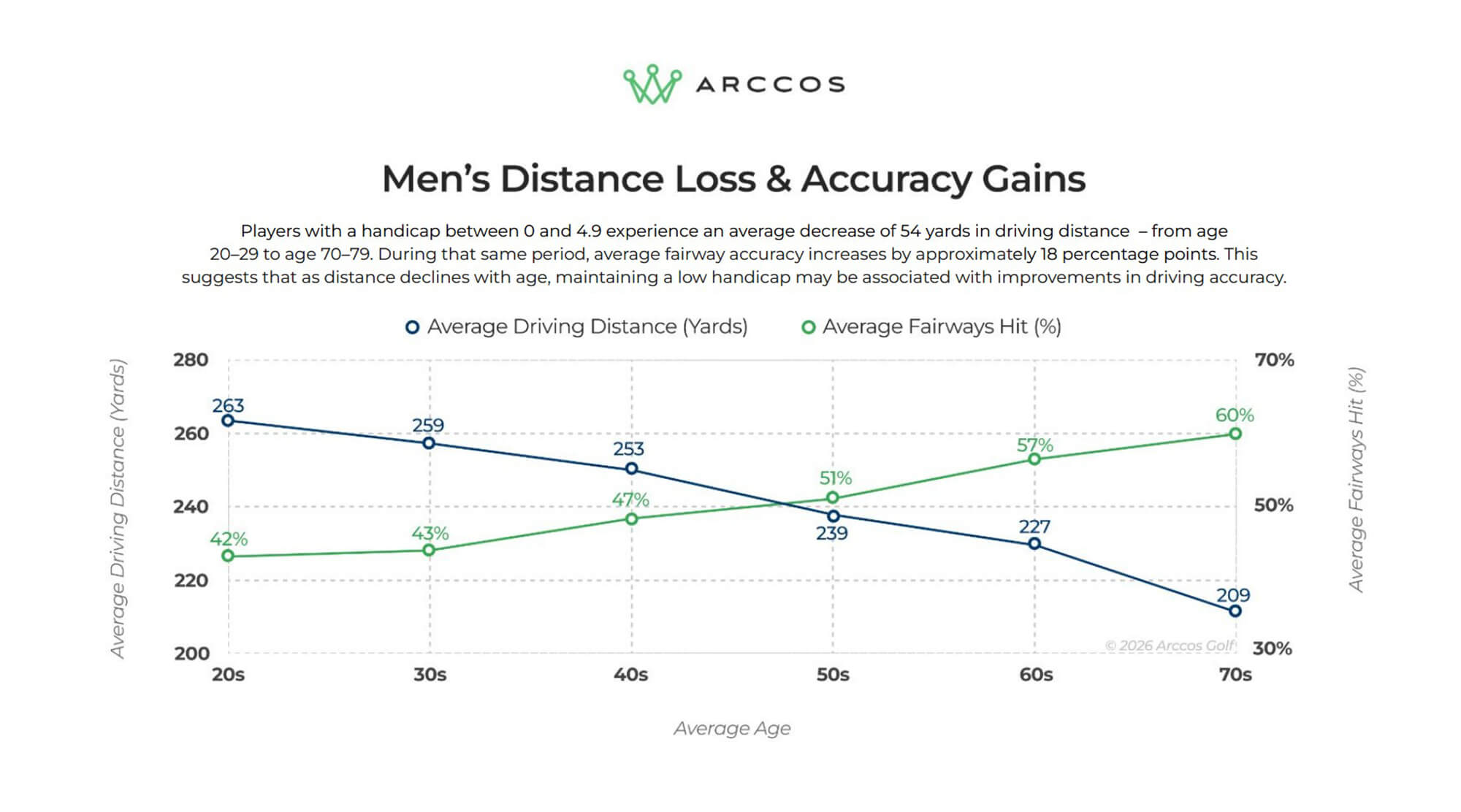
Men 15 to 19 average 240 yards off the tee. Men in their 70s average 190.

Fifty yards. Roughly a club and a half. It’s like the Bandon wind, except it never changes direction.

The flip side is more interesting. Over those same five-plus decades, fairways-hit climbs from 38 percent for men in their 20s to 56 percent for men in their 70s. Old guys lose distance. They also stop hitting it sideways.

Whether that’s because they’ve finally figured something out or because they physically can’t swing hard enough to spray it, I’ll let you decide.

Either way, at least we have something to look forward to.

Skill, not age, is the bigger driver of distance
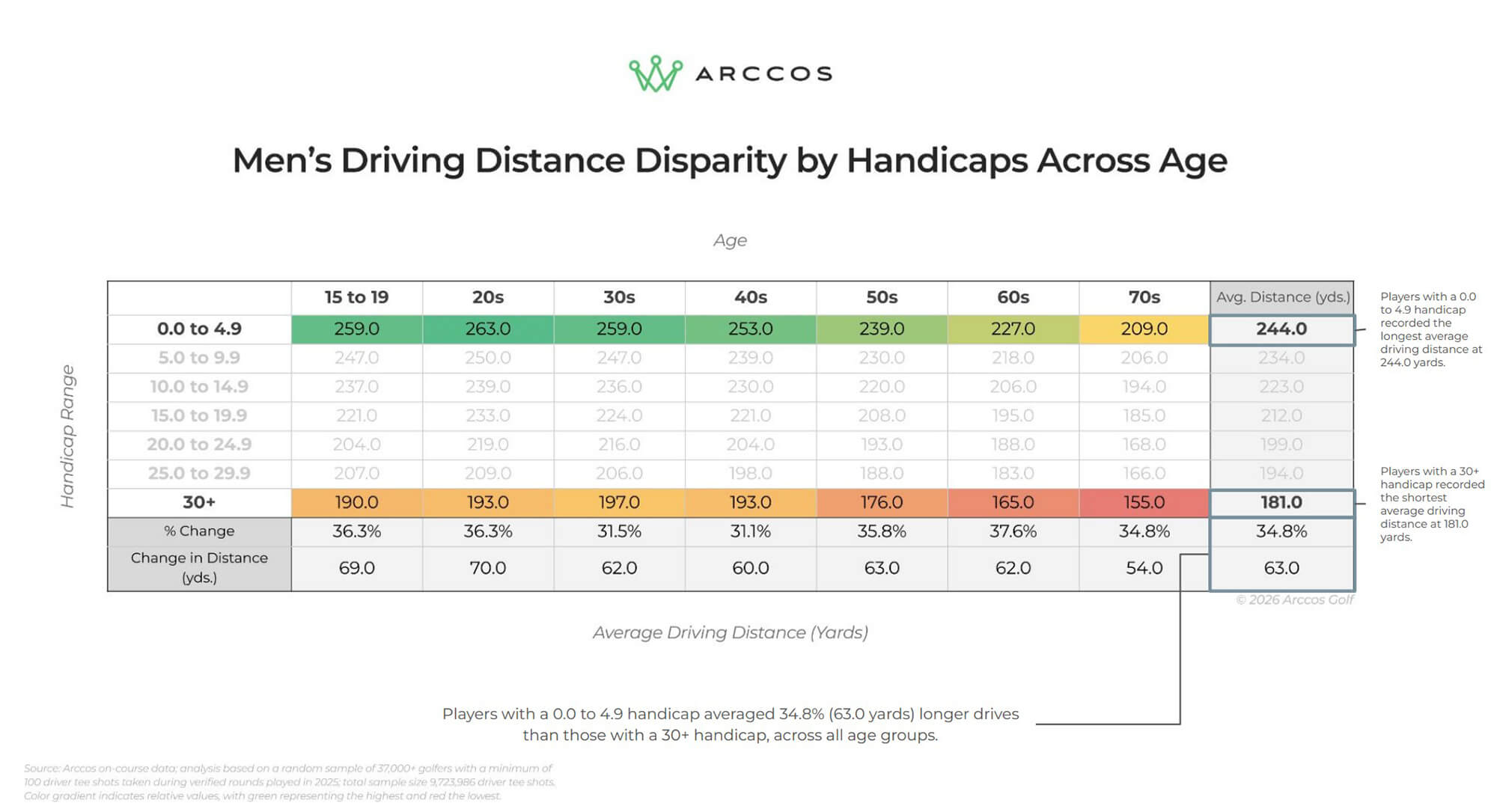
Sort the men’s data by handicap and the gap is brutal. A scratch-to-4.9 averages 244 yards off the tee. A 30-plus handicapper averages 181.

Sixty-three yards. Across every age bracket. No asterisks.

For context, the entire age spectrum—from teenagers all the way through men in their 70s—accounts for a 50-yard distance gap. The handicap spectrum, at any given age, accounts for 63. Said differently: a 30-handicap in his 20s hits it shorter than a scratch in his 60s. Skill, not age, is the single biggest variable in how far an amateur hits a driver.

For women, the handicap spread is wider still: 75 yards between the lowest- and highest-handicap groups.

“Drive for show, putt for dough” remains one of the great lies in golf. Better players don’t just chip and putt better. They hit it materially farther off the tee.

And no, your one good drive last Sunday doesn’t count.

Accuracy isn’t the equalizer (the wayward shot is)
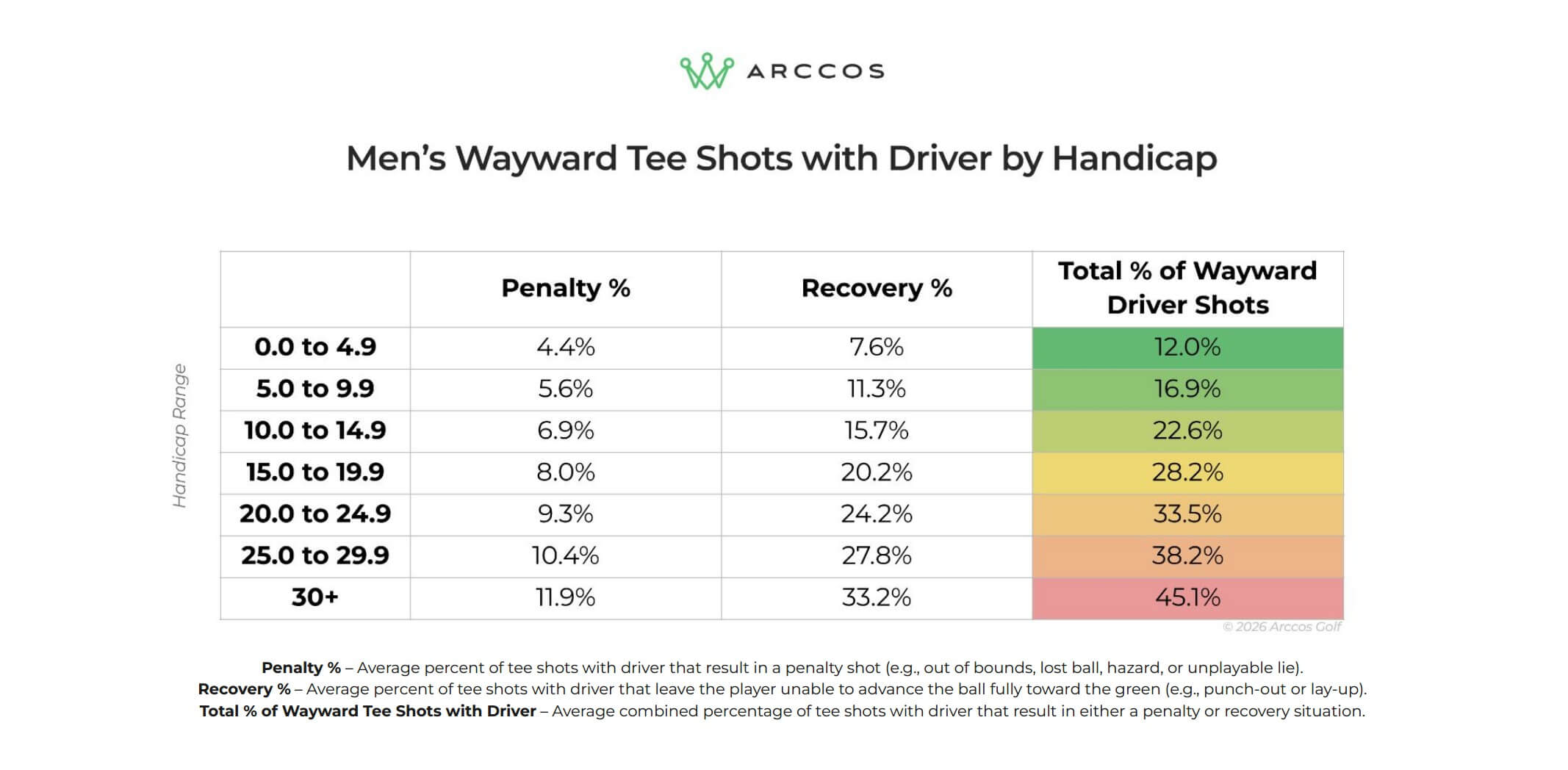
The high-handicap “yeah, but I’m always in play” defense doesn’t hold up either.

Scratch-to-4.9 men hit the fairway 50 percent of the time. The 30-plus group hits it 40 percent. A 10-point gap, but not catastrophic.

The catastrophic number is what happens on the misses.

According to Arccos, 12 percent of drives by scratch-to-4.9 players result in either a penalty or a forced recovery—punch-outs, lay-ups, lost balls, no realistic shot at the green. For the 30-plus crowd, that number is 45 percent.

Read it again. Nearly half of every drive a 30-handicap hits ends with either a stroke on the card or a sideways pitch back into the fairway. The lost ball gets the headlines. The recovery shot is what’s quietly running up the score. At 33 percent of all 30-plus drives, it’s nearly three times the penalty rate.

The data is what the data is, but nevertheless, I feel bullied on a deeply personal level right now.

Women’s accuracy doesn’t track handicap
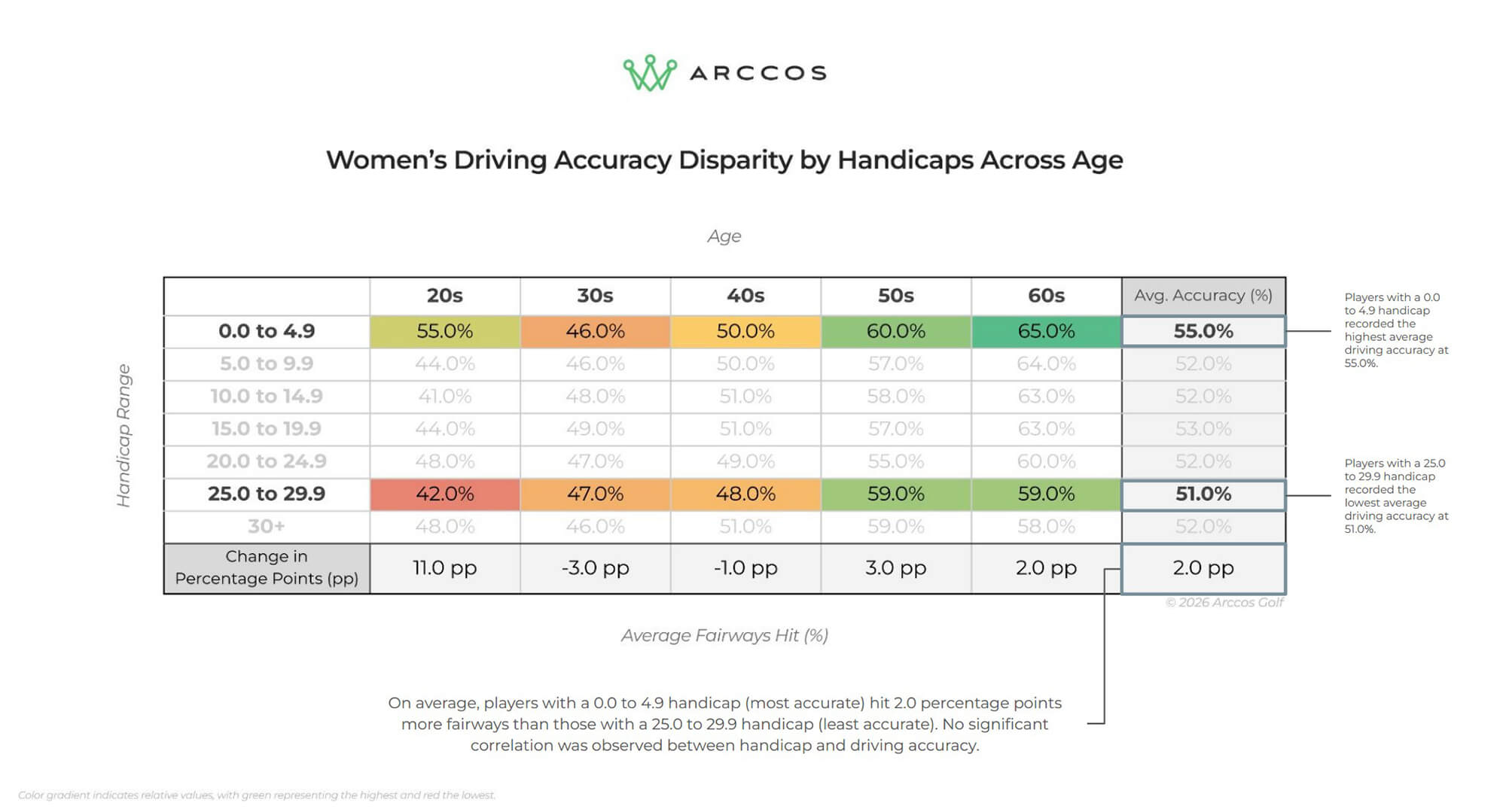
I saved this curious one for last.

For men, fairway accuracy improves with handicap. Modestly, but it improves.

For women, it basically doesn’t. The most accurate handicap group (scratch-to-4.9) hits 55 percent of fairways. The least accurate (25-to-29.9) hits 51 percent. Four points across the entire skill spectrum, and Arccos itself notes there’s no meaningful correlation between women’s handicap and women’s driving accuracy.

Where the men’s better players are longer and straighter, the women’s better players are mostly just longer. The skill divide off the tee, for whatever reason, shows up almost entirely in yards.

If you’ve got a theory, I’m all ears.

The takeaway

Eight years in, the Arccos data continues to make a hard-to-argue case that the recreational distance “crisis” is essentially a fiction. Men haven’t gained a yard. Women have lost a few. Skill moves the needle more than age. And what separates the best amateurs from everyone else isn’t the fairways they hit—it’s the trouble they manage to avoid.

You can dig into the full 2026 Arccos Driving Distance Report (including year-over-year breakdowns by age and handicap going back to 2018) here.

For You

For You

News
Jun 19, 2026
USGA Spot On With Shinnecock Setup During Blustery Opening Day
News
Jun 19, 2026
PAYNTR’s Rise Is No Accident: Five MyGolfSpy Members Tested The Reserve Classic Tour RS
News
Jun 19, 2026
Scratch By 50: I Switched From The Worst-Rated Driver To The Best-Rated Driver
Tony Covey

Tony Covey

Tony Covey

Tony is the Editor of MyGolfSpy where his job is to bring fresh and innovative content to the site. In addition to his editorial responsibilities, he was instrumental in developing MyGolfSpy's data-driven testing methodologies and continues to sift through our data to find the insights that can help improve your game. Tony believes that golfers deserve to know what's real and what's not, and that means MyGolfSpy's equipment coverage must extend beyond the so-called facts as dictated by the same companies that created them. Most of all Tony believes in performance over hype and #PowerToThePlayer.

Tony Covey

Tony Covey

Tony Covey

Tony Covey

Tony Covey


    This site is protected by reCAPTCHA and the Google Privacy Policy and Terms of Service apply.

      indyvic

      1 month ago

      Reading this article I was shaking my head yes in agreement. As someone who started this game ’bout in ’85 I have ‘lived’ most of these reports about ‘longest, most improved, yada yada drivers’ to be hustled to the general recreational player. Being a banged up senior player these days I have went with some of the best Ping’s, Cobra, Callaways, Mizuno St and now a new Callaway Paradym X and the distance has been mostly very small between them price however has been significant. Browsing eBay I chanced to see an old Nike Lucky 13 for 75 bucks or so and remember hitting the rear flag area on the driving range with it shot after shot. All these years later I can’t do that anymore sure I’m older etc. but where are all these ‘super drivers’ that take center stage every year? For me and I suspect many others too, it just isn’t there no matter what I’m willing to pay. Is there more ‘spring effect’ in my new driver since the rules changes and be legal, no. IMO buying the latest expensive driver is like the ruse used to sell fishing lures the fisherman is the hook not the fish. At 185-210 yds these days except for hard fairways and a favorable breeze, hell I might as well go back to a 2019 area driver and keep the change and I might do just that. And yes I like to work the ball but it ‘ain’t’ going any longer just like that play. My bag now has two FW’s to get me close, three irons and three wedges so I can make my scoring shot attempts. No new drivers for me learn your distances with your clubs, manage your course, save your dough and have fun being confident within your abilities and club selection. Works for me anyway as i go out this year to maintain my 12 hdcp. from last year and shoot my age!I IMo of course…

      Reply

      Elmer Figglestein

      2 months ago

      Just my theory, but a played with a couple of very good female golfers recently and as the data would suggest, they are CONSIDERABLY longer off the tee than the average female at a public course. They played from the women’s tees and in some cases they have a much tougher time hitting the fairway because of doglegs where they either have to come in at an angle since they hit it past the dogleg or go over and very close to trees on the inside of doglegs. Could they hit less than driver on some holes – sure but remember those doglegs are generally made to turn at a distance that good male golfers can handle – laying up to 200 yards out is doable for many males, but much more challenging for all but LPGA golfers.

      Reply

      Frank Cruthers

      2 months ago

      On what planet is 50 yards a club and a half?? That would be a gap off @ 33 yards between clubs.

      Reply

      Franc38

      2 months ago

      I think the sentence was 4 clubs and a half but the 4 got lost in the process…

      Reply

      Tim B

      2 months ago

      Hi Tony. All very interesting. Hard to argue with such a large data set. Yes, there might be some outliers but overall the data seems to confirm what I see every week on the golf course. I am a 70 year old male, with 3-4 hcap. I am now 50 yards shorter off the tee than 10 years ago (same Titleist Driver & Diamana kai’li shaft). My accuracy off the tee has remained pretty good. But my hcap is slightly lower. This is because I have finally learned to play smarter (everyone knows where the flag is, not many really focus enough on where & when not to miss). My results on any given day are now a function of my putting. If I putt well, I score well (period). For your question on the Ladies, there seems no doubt that the longer gals are generally the lower handicappers. That is the case at my Club. I think the reason for this is that they are therefore playing very short irons into a lot of greens, which leads to better scoring (and easier recoveries if necessary). On the ball ‘roll-back’ point, I am 100% against this idea. The only players arguably hitting the ball ‘too far’ (whatever then means) are the elite Tour pros. No Amateur wants to hit the ball shorter (the contra is true). Why change something that impacts less than 0.001% of golf players. Amateurs want to use the same kit as the Pros and the ball is one of the few areas where this is possible. It seems to me that everybody promoting this ‘roll-back’ has skin in the game (course designers to name but one cohort). The powers that be should focus on more important matters ….

      Reply

      Greg

      2 months ago

      I’m not surprised. Nor do I believe the average score for all golfers is in the low 90s or even upper 80s, as I’ve read. If everybody played by the rules and counted them all, I doubt half of all golfers could break 100. I’ve been playing for 65 years now, including high school and college golf, and many pro-ams and amateur events, as well as recreational golf, and this is my experience. I don’t think equipment is the answer to more distance and lower scores. Instruction accompanied by practice works, but not many golfers take advantage of it. I guess it’s easier to believe you can buy a better game. And I think equipment companies are happy to self that myth–not that I blame them.

      Reply

      gt

      2 months ago

      Of course older guys hit more fairways then younger guys, we don’t hit it as far. If I hit the ball 220 and mishit it I might still catch the right FW or the first cut. Another guy who hits the exact same shot but hits it 250 is OB. And the big hitter who hits it 300 is off the planet. I’d like to think my 80% fairways hit is skill but I know a lot of it is just a lack of distance.
      Probably even more so for women. As someone else mentioned the women’s tees are often literally IN the fairway so ev en a muffed ground ball is a fairway hit. And since tons of women are hitting it max 150 it’s hard to even hit a slice out of the fairway.

      Reply

      Michael

      2 months ago

      A few thoughts: 1. If Arcos data were so inaccurate, they would have been exposed by now and be out of business. Even TV broadcasts rely on it. 2. It is hard to believe that all of the players using Arcos are still using 2018 drivers, especially at the lower handicap levels. These are the folks who buy the newest ( as am I) in hopes of gaining or maintaining results. Manufacturers would be bankrupt if all of these Arcos players had not bought new clubs since 2018. 3. Arcos itself is a relatively new thing – would players buy Arcos and still be using their 2018 driver? I think not. 4. Finally, there may be small flaws in the data – there always is in any data set – but it is hard to escape the fact that the idea that recreational golfers’ gain in distance is ruining the game is a total myth. Whatever the “problem is at the pro / elite level, it does not carry through to the recreational level, even low handicap golfers. Pros train for golf like every other pro athlete. A recreational player is not going to hit a baseball over 350 feet (with a wood bay), or pitch a baseball over 100mph, or serve a tennis ball at the speed of Sinner and his colleagues. They train; they practice; and they achieve performance levels that the rest of us can only admire. So, USGA, don’t give us the BS that distance gains require dialing back the ball.

      Reply

      Bryan Reynolds

      2 months ago

      Not sure how accurate the amalgamated Arcos data is…but I do agree that the distance problem the governing bodies seem so obsessed with does not exist for 95% of the golfing world. It really only exists in professional and very high level amateur golf for males. Bifurcation anyone? One possible explanation for the lack of change to accuracy for women of differing skill levels might be related to the positioning of red tees on most courses. Most of them are quite generous, placing the player right at the edge of the fairway or even surrounded by fairway. Combined with the fact that a shorter shot will not go as far off line as a longer one when struck the same degree from the target, I often see ladies and seniors playing from those tees in the fairway – even if the shot was not great. When a similar shot from the white tees may have found the rough or even a penalty area in front of the tee box.

      Reply

      Frank Cruthers

      2 months ago

      add in the difference between men & women regarding the slice that so many men suffer with as compared to the relatively straight drives that even higher handicap women seem to hit.

      Reply

      Ganno

      2 months ago

      It’s all in the hips!

      Andrew the Great!

      2 months ago

      Has ANYONE ever independently tested Arccos for accuracy? Or Shot Scope or Trackman or Rapsodo or Garmin, et al, for that matter? We seem to assume that these electronic measuring devices are accurate enough…TO THE HALF-YARD???…but I have never, EVER heard or read or seen ANY evidence proving the accuracy and the margins of error of these devices against a physical measuring device. Has anyone??

      Reply

      Rich Quinn

      2 months ago

      I believe the Arcos data is scewed when it comes to driver distance. I am 57. 10.0 handicap. My average drives are 235. I used Arcos for a season and a half and it said my average distance was 174. All of the mishits, tugs short left, etc happen way more often than my occasional 280 bomb but still not often enough to believe that I only average 174. I know my average is from using 18 Birdies and tracking every shot. I throw out the mishits and any lucky bombs downhill or whatever because I feel that is the most accurate representation of my real driver distance. Until Arcos has a way of managing the mishits better the data will never be truly accurate or useful.

      Reply

      Ganno

      2 months ago

      Completely agree on skill versus age. I took up golf in my early-to-mid thirties and always used my pitching wedge as a barometer of skill – for ages struggled to get it 100 yards. Now in my early forties and this last year feel like my progress has really accelerated, with my PW becoming my 120-130 yard club. This last couple of weeks something really clicked with my swing and I feel i finally understand how to swing a club (at least irons). Needed to hit a 130 yard shot this last weekend, slightly uphill and so grabbed the PW as usual. Made great contact with the new swing and hit it into the trees beyond my target – 160 yards on the dot. Feel like golf is one thing that you can actually get better with age (and experience)

      Also interesting that 2021 saw the lowest average driver distance for men whilst the highest for women, wonder what was behind that.

      Reply

      Golfmiburk07

      2 months ago

      Wait though, does this report take into account what driver golfers are using? Because this argument of not having more distance would be based on every player using 2018 model drivers in 2018 and using 2025 model drivers in 2025. I will disagree with the premise of this article from that standpoint, unless the data set is providing total transparency for what clubs are being used, this article isn’t completely accurate for what it’s trying to argue.
      Now I will say that most amateurs aren’t consistent enough to actually be gaining several yards of distance each year, but the argument of this article is flawed without knowing exactly what clubs are being used for the data set.

      Reply

      Steve

      2 months ago

      Not sure that matters much. Maybe, there are more (relatively) older drivers in 2018, but I doubt it. Rather, this supports the general notion that clubs have basically been maxed-out… It also calls into question whether the ‘mygolfspy best driver’ really matters as much as claimed each year.

      Reply

      KJC

      2 months ago

      I liked the article and the analysis. I am in that 70s group with a 5.3 index. My data, manually kept, because that’s what old people do, reflects these trends. One theory why women are straighter because they get their distance from lower body first sequencing and a straighter path. Men are wood choppers and think upper body first which results in over the top action. To test my theory one would need to measure swing path and face angle based on sex, handicap and/or age.

      Reply

      Robert Teale

      2 months ago

      A most thought provoking report. I wonder what physical fitness plays with age and distance?
      I’m 76 and have a goal to improve my handicap to a 15 my take off is practice more accuracy not more distance. I’ve shared the report with the senior golfers group I belong to.
      Thanks

      Reply

    Leave A Reply

    required
    required
    required (your email address will not be published)

    This site uses Akismet to reduce spam. Learn how your comment data is processed.

    News
    Jun 19, 2026
    USGA Spot On With Shinnecock Setup During Blustery Opening Day
    News
    Jun 19, 2026
    PAYNTR’s Rise Is No Accident: Five MyGolfSpy Members Tested The Reserve Classic Tour RS
    News
    Jun 19, 2026
    Scratch By 50: I Switched From The Worst-Rated Driver To The Best-Rated Driver