


The last time I went for an iron fitting, I was pretty quickly put into the player’s distance category. I liked the irons I was fitted into and I still think they are great for my game.
But it also made me wonder if there was more to the decision than simply saying, “You’re a player’s distance golfer.” What happens if I put player’s iron in the bag instead?
I’ve played player’s irons before although it was a long time ago. They were shorter and less forgiving when I missed the center of the face.
So I dug into MyGolfSpy testing data to see what happens when the same golfers hit player’s irons and player’s distance irons. Instead of limiting this to 2026, we went back through every year where we had enough crossover between the two tests to make a useful comparison.
Here’s what we ended up with:
- Eight test years between 2018 and 2026
- 88 matched golfer comparisons
- 102,244 shots
- Only golfers who tested both categories in the same year were included
We aren’t comparing one group of player’s iron testers to an entirely different group of player’s distance testers. Each golfer is being compared against themselves, using the same ball and hitting both categories in the same year.
How much distance do player’s distance irons really add?
The basic answer is about six yards with the longer irons and closer to four yards with the pitching wedge.
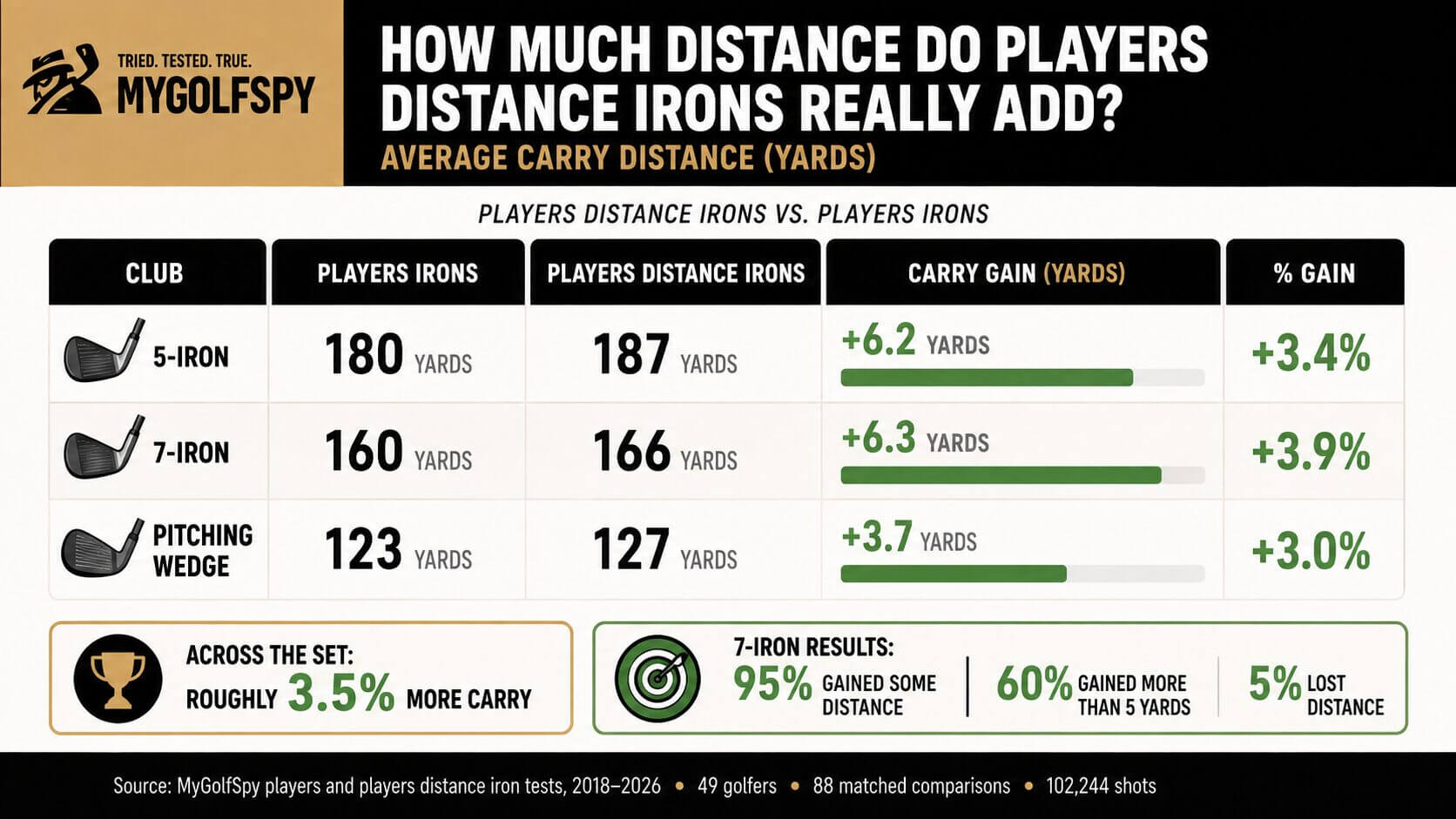
The 5-iron gained 6.2 yards of carry, the 7-iron gained 6.3 and the pitching wedge gained 3.7. Across the set, that works out to roughly 3.5 percent more carry.
Six yards in an iron matters. But it’s worth keeping that gain in perspective. We aren’t finding 15 or 20 yards simply because the iron falls into a different category.
With the 7-iron, 84 of the 88 matched comparisons produced more distance with the player’s distance iron. Ninety-five percent gained at least some distance, 60 percent gained more than five yards and only five percent ended up shorter.
The analysis estimates that roughly 70 percent of the extra carry comes from additional ball speed. The rest comes from a flatter, lower-spinning flight.
Stronger lofts are part of the equation but there’s more to it
Player’s distance irons delivered less loft at impact, launched lower and spun less. With the 7-iron, delivered loft was 1.90 degrees lower, launch was 0.98 degrees lower and spin dropped by 412 rpm.
Stronger lofts are clearly helping create some of the distance. The more interesting question is whether the stronger lofts explain all of it.
We can use the golfer’s own data set to get an idea of what should happen if loft were the entire reason for the additional distance. Moving from one iron to the next stronger club tells us how much distance that golfer normally gains and how much height, launch, landing angle and spin they normally give up in exchange.
The player’s distance gain with the longer irons was worth roughly six-tenths of a club. If the distance increase came purely from stronger loft, peak height should have dropped by 0.95 yards. It dropped by just 0.18. Landing angle should have become 1.51 degrees shallower. The measured change was 0.88 degrees.
The additional ball speed player’s distance irons provide is helping recover much of the flight you would expect to lose from stronger loft.
Spin is the exception. The predicted loss was 360 rpm and the measured loss was 354 rpm so when it comes to spin, you’re paying almost the entire price you would expect.
What do those six extra yards cost?
The extra yards are helpful but do they come at a cost?
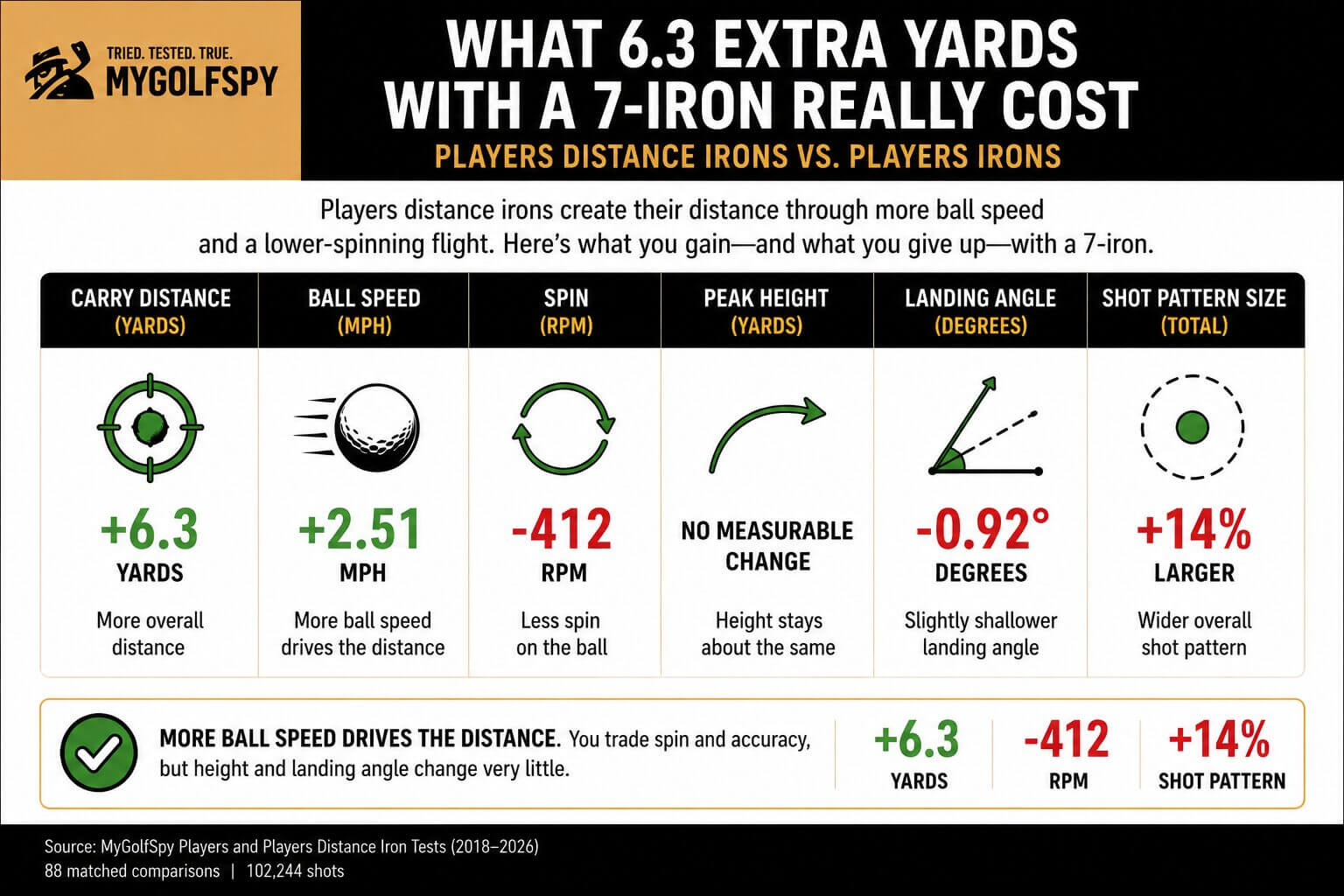
With the 7-iron, player’s distance irons produced 6.3 extra yards of carry and 2.51 mph more ball speed. In exchange, spin dropped 412 rpm, landing angle became 0.92 degrees shallower and the overall shot pattern grew by about 14 percent. Peak height did not change measurably.
I think that last part is important because a lot of golfers assume the trade for more iron distance is a much flatter ball flight that won’t hold a green. The data doesn’t really show that.
Peak height didn’t change measurably with either the 5-iron or 7-iron. The player’s distance pitching wedge was slightly higher while landing angle became about 0.9 degrees shallower with the 5- and 7-iron and showed essentially no change at the pitching wedge.
The loss of height and landing angle is considerably less than I would have expected.
The accuracy tradeoff may matter more
With both the 5-iron and 7-iron, the overall shot pattern grew by about 14 percent with the player’s distance irons. Most of that additional dispersion was lateral. Carry consistency also slipped slightly, by about a quarter of a yard. With the pitching wedge, there was no meaningful accuracy penalty.
That gives us a pretty clear trade at the longer end of the set. You gain about six yards but your overall shot pattern becomes roughly 14 percent larger. At the scoring end, you gain less distance but the accuracy penalty essentially disappears.
Player’s distance irons can change your wedge gaps
The distance gain is not equal throughout the set. You gain 6.2 yards with the 5-iron but only 3.7 with the pitching wedge so the same number of clubs ends up covering slightly more total distance.
The bigger issue is what happens below the pitching wedge. If your old pitching wedge carries 123 yards and the player’s distance pitching wedge carries 127, the wedges already in your bag haven’t changed. Those four extra yards get added directly to the gap between your pitching wedge and the next wedge.
Thirty-six percent of golfers in this analysis gained more than five yards with the pitching wedge. On a normal 12- to 15-yard gap, adding another four or five yards can make that gap noticeably larger.
If you move into player’s distance irons, checking the bottom of the set should be part of the fitting.
How this looks at the club level
The averages make player’s distance irons look pretty clearly longer. Once we start comparing individual models, there’s more overlap.
With the 7-iron, the longest player’s iron a golfer tested was essentially even with the typical player’s distance iron. The shortest player’s distance iron was 6.8 yards behind the longest player’s iron for that same golfer. We also found that about 12 percent of player’s irons out-carried the player’s distance category average at the 7-iron.
The important takeaway here is that a well-matched player’s iron can give you similar distance while potentially changing some of the other tradeoffs we found. The specific head still matters.
Does swing speed change anything?
The 7-iron testers ranged from 80 to 93 mph and there was only a 1.6-yard difference in the player’s distance gain between the slowest and fastest swingers.
There was no meaningful relationship between swing speed and the distance advantage with the 5-iron, 7-iron or pitching wedge. Within the swing-speed range represented in this testing, faster players weren’t getting significantly more benefit from the category than slower players.
The 2026 gap was the smallest we’ve seen
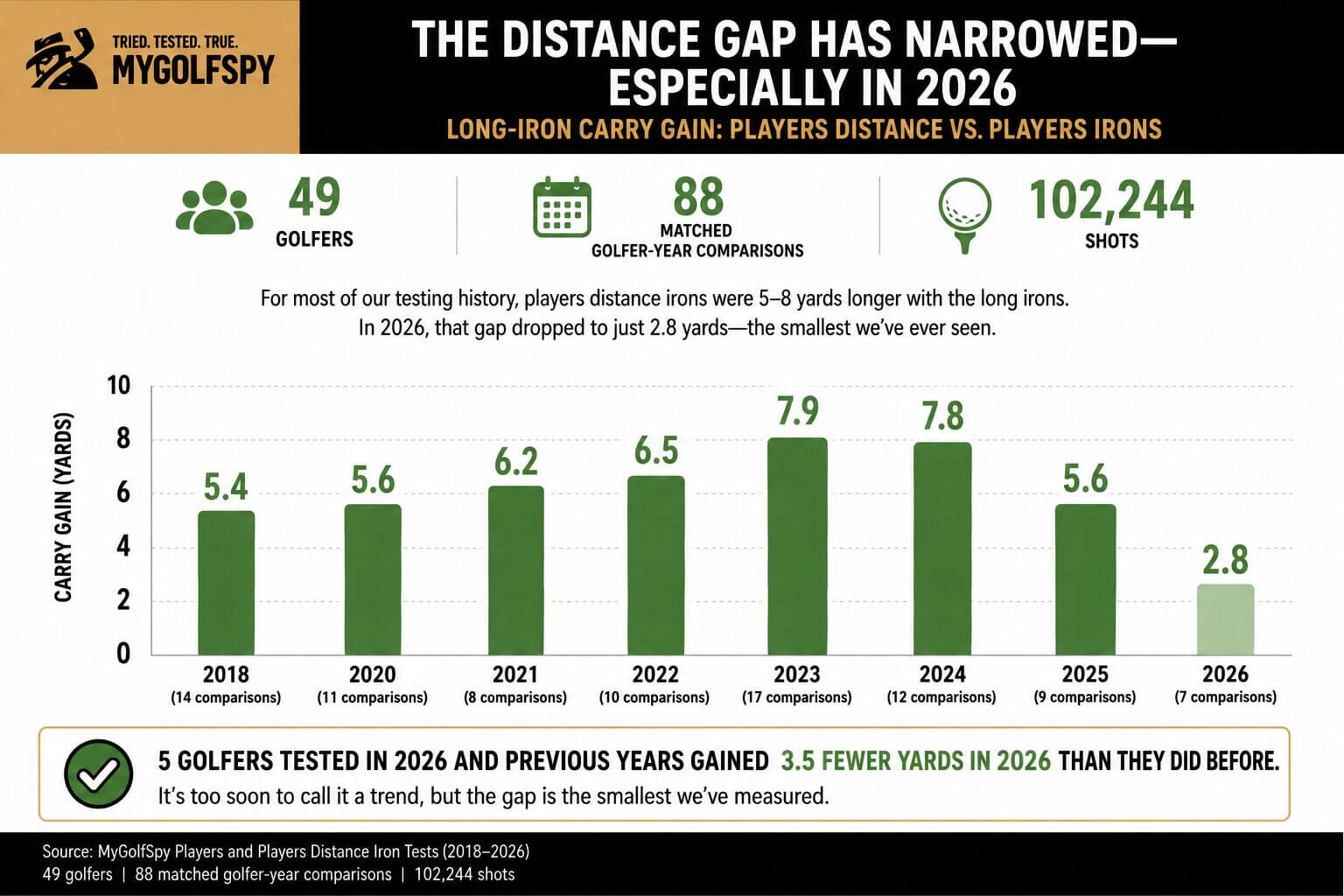
Player’s distance irons on average were just 2.8 yards longer with the long irons in 2026. That is less than half the 6.6-yard average from the previous seven tests. The gap had reached 7.9 yards in 2023 and 7.8 in 2024 before dropping to 5.6 yards in 2025 and then 2.8 in 2026.
It’s tempting to say the categories are starting to converge but we don’t have enough evidence for that yet. Five golfers who participated in 2026 also appeared in at least one earlier year. Those same golfers gained about 3.5 fewer yards from player’s distance irons in 2026 than they had previously.
Maybe player’s irons are getting faster. Maybe the player’s distance models tested this year weren’t pushing distance as aggressively. Maybe it was simply the particular mix of products. We can’t answer that yet but a 2.8-yard gap after years of seeing five to eight yards is something worth watching.
Final thoughts
Player’s distance irons are longer as a category. After looking at more than 100,000 shots, I think the better takeaway is that the category name is only the starting point of your next fitting. There’s a good chance some of the irons that would be a good fit for your game are categorized in a way that would otherwise make you ignore them. Use all the data you can to put the best tools in your golf bag.





WYBob
2 months ago
I went through a fitting 1.5 months ago and the 7i distance difference between the Players iron (MP S-3) and a quasi Players Distance iron (MP M-13) was approx. 2 yards. The dispersion with the S-3 was better overall. The net/net was that I could play either iron and achieve pretty much a similar result so the choice will ultimately get down to feel and aesthetics. One key walk away was that being fitted into the correct shaft makes a huge difference. Much of the distance gap between the two type of irons was negated by being fit into the correct shaft. As I recall the MGS tests clubs using the standard shaft offerings which may help explain some the distance deltas you’ve identified. IMHO the MGS testing provides a good starting point for the discussion with a competent fitter but getting fit, especially for the correct shaft, is of extreme importance if you want to optimize your performance.