


Walk into an iron fitting and you can have a lot of numbers thrown at you. Ball speed, launch, spin, peak height, carry, total distance and descent angle all have some value.
We collect many of those same numbers in MyGolfSpy iron testing but, after spending so much time looking at our data, I don’t think they all deserve equal attention.
If you told me I could see only three numbers before buying an iron, I’d want carry distance, carry distance consistency and descent angle.
Together, they answer three pretty important questions. How far does the ball really fly? Can I expect it to fly roughly that distance again? And when it gets to the green, is the flight useful enough to give me some control?
That tells me a lot more about whether an iron belongs in my bag than knowing which one produced the biggest total distance number.
1. Carry distance
I want to know how far the ball flies through the air, not how far it eventually finishes. If I need to carry a bunker, water or the front edge of a green, total distance doesn’t help much. Carry does.
It’s also easy to get distracted during a fitting when a new 7-iron suddenly goes farther than your current one.
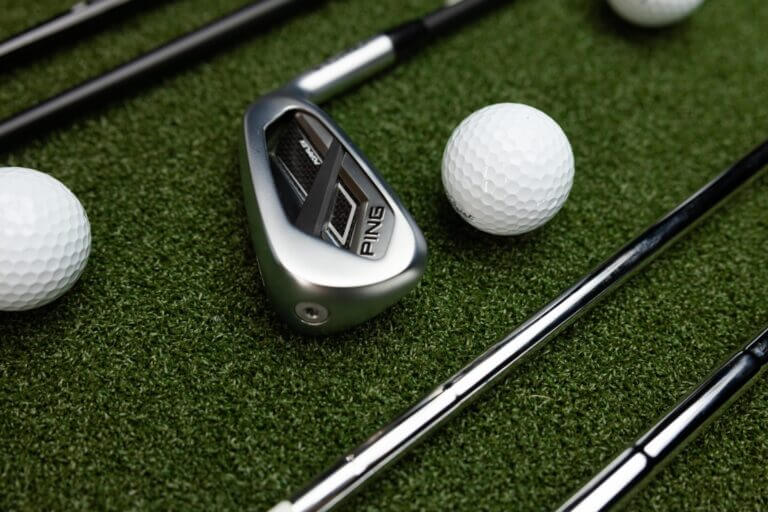
The PING i540 was the longest player’s distance iron in our 2026 test at 159.64 yards of carry. The Wilson DYNAPWR Forged averaged 154.36 yards, more than five yards shorter, but Wilson finished first overall because it combined enough distance with better accuracy and forgiveness.
Distance matters. I just want to know the distance that helps me choose the right club for the shot in front of me and that’s carry distance.
2. Carry distance consistency
Knowing your average carry is only useful if the club produces something reasonably close to that number again.
Two irons can average 165 yards while producing completely different results. One might stay between 162 and 168 while the other jumps from 155 to 173.
The average is identical but your experience on the golf course will look much different.
If I have 165 yards to a green, I want to make a normal swing and have some confidence the ball is going to finish in the neighborhood I expected. A club that occasionally gives me 173 and occasionally 155 makes that much harder.
When we evaluate forgiveness in our testing, we want to know how much performance changes from shot to shot, not just what the overall average looks like.
You may not see “carry delta” displayed as one of the primary numbers during a fitting but you can still use the idea. Look at the individual shots and ask your fitter what they are seeing in the carry spread.
I’d rather have an iron that gives me 163, 165 and 166 than one that gives me 156, 166 and 173, even if the second club produces the more impressive shot of the fitting session.
Predictable distance is important when you’re trying to score.
3. Descent angle
Descent angle is probably the least obvious of my three. I don’t think many amateur golfers pay much attention to it but the more I’ve looked at iron test results, the more important I’ve realized this number is.
Launch and spin both matter but, if I only get one number to help me understand whether the ball flight is useful when it reaches the green, I want descent angle.
A shot can carry the right distance and still arrive at the green in a way that makes it difficult to control.
That becomes especially important as you move into the longer irons. Many golfers reach a point where they can still generate decent carry distance with a 5-iron or 4-iron but they can’t launch it high enough or bring it down steeply enough to hold a green.
If you’re in a fitting, compare the descent angle of your 7-iron with your 5-iron. Then look at what happens as you move farther up the set. At some point, you may see the flight start to flatten.
That could be a sign that another long iron isn’t the best choice and that a hybrid or higher-lofted fairway wood may give you a more useful ball flight. A flatter descent can give you some extra rollout but that’s not necessarily what you want from an approach club.
Final thoughts
If you go for a complete iron fitting, you likely won’t have to choose just three numbers to look at. But if you put these three together, you’re getting much closer to the question I care about when choosing an iron: If I make my normal swing, can I predict what this club is going to do?





Mike Humphrey
4 seconds ago
Some launch monitors, and therefore fittings, display Standard deviation. So average carry with a lower standard deviation is good.