


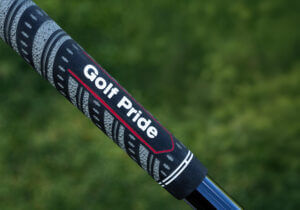
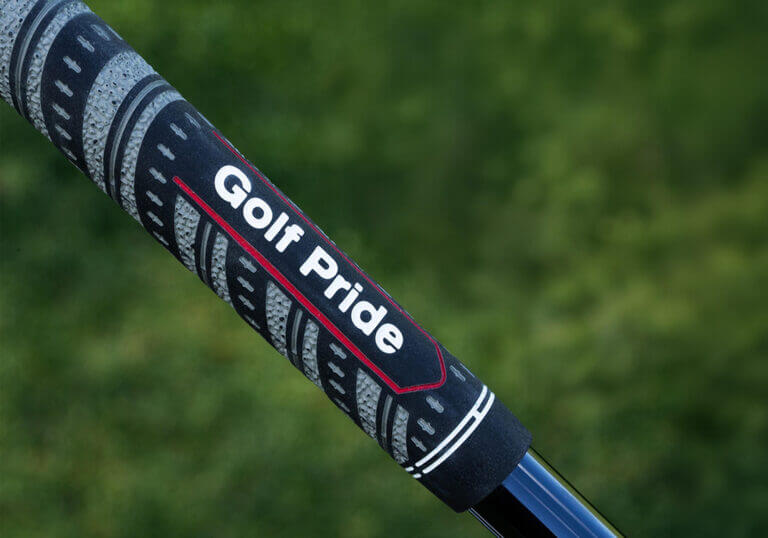
I have small hands and I play undersized grips. Last year when I talked to Golf Pride, they told me they’ve been seeing more and more golfers sizing up and that’s having a real impact on how those players hit it. They find that many golfers are playing standard when in fact midsize would be a better fit.
After that discussion, I put a standard sized grip on my 7-iron to give it a try.
Here’s the thing: even when I go up to a standard-size grip, I struggle to close the face. So which is it? Is the grip doing that to me, or is it my swing, my hand position, something else entirely? Here’s what you should know before you blame the grip.
Why grip size gets blamed for a slice
A slice happens because the club face is open relative to your swing path at impact. A thicker grip sits deeper in your palms and can quiet hand action through the swing. Less hand action can mean less club face rotation which in theory can leave the face open longer through impact. That’s the logic behind the idea that a bigger grip could be the issue causing a slice.
What Golf Pride’s own fitting process checks
Golf Pride’s own sizing method starts with two simple measurements: the length from your wrist crease to your middle fingertip on your lead hand and your glove size as a cross-check. From there, they don’t just hand you a chart number and send you off. They want to see how your fingers actually sit on the grip.
- On the right size, your fingers barely touch the heel pad of your upper hand.
- On a grip that’s too small, your fingers wrap underneath the heel pad.
- On a grip that’s too big, your fingers don’t reach the heel pad at all.
That last one is the checkpoint that matters most for a slice. If your fingers can’t reach the heel pad, you don’t have full control of the club through impact and the face has a much easier time staying open. It has less to do with “thick grips restrict hands” as a blanket rule and everything to do with whether this specific grip fits your specific hand.
If you land between two sizes, Golf Pride’s own guidance is to add two to four wraps of tape rather than jumping a full size, since a full jump can overcorrect.
How to tell if your grip size is the actual problem
Take your normal grip and look down at your lead hand. Do your fingers just barely touch the heel pad or do you not reach it at all? If you’re on a larger grip and your fingers fall short of the heel pad, that’s a real fitting issue and sizing down could help your face control. But if your fingers reach the heel pad fine and you’re still slicing, the grip probably isn’t your problem. That’s a swing path or face angle issue.
What to try
Start with a grip check. Have a fitter take a look and watch for that heel pad gap. Grip size can tip an existing tendency one way or the other but it’s rarely the root cause on its own.









Duffer1
3 months ago
I have small hands. I never noticed if midsize grips cause a slice, but my midsize +4 grips cured my hook.