


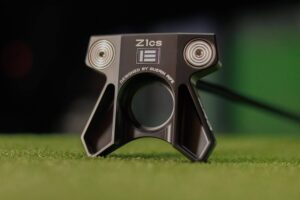
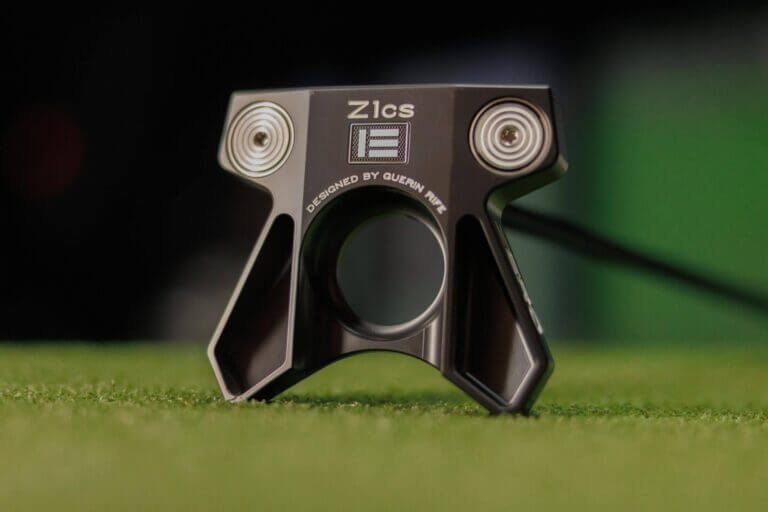
The first time I spent any real time with a zero torque putter, I remember thinking that it had taken my job away.
I’ve played golf almost my entire life and, with a putter in my hands, I’ve always known part of my job was to manage the face. The putter opens during the stroke, it closes coming through and I have to get it back to square at impact.
With a zero torque putter, I didn’t feel like I had to do nearly as much.
That experience made me start looking at zero torque a little differently. Instead of asking whether the technology works, I think the better question is who benefits from having less face rotation to manage.
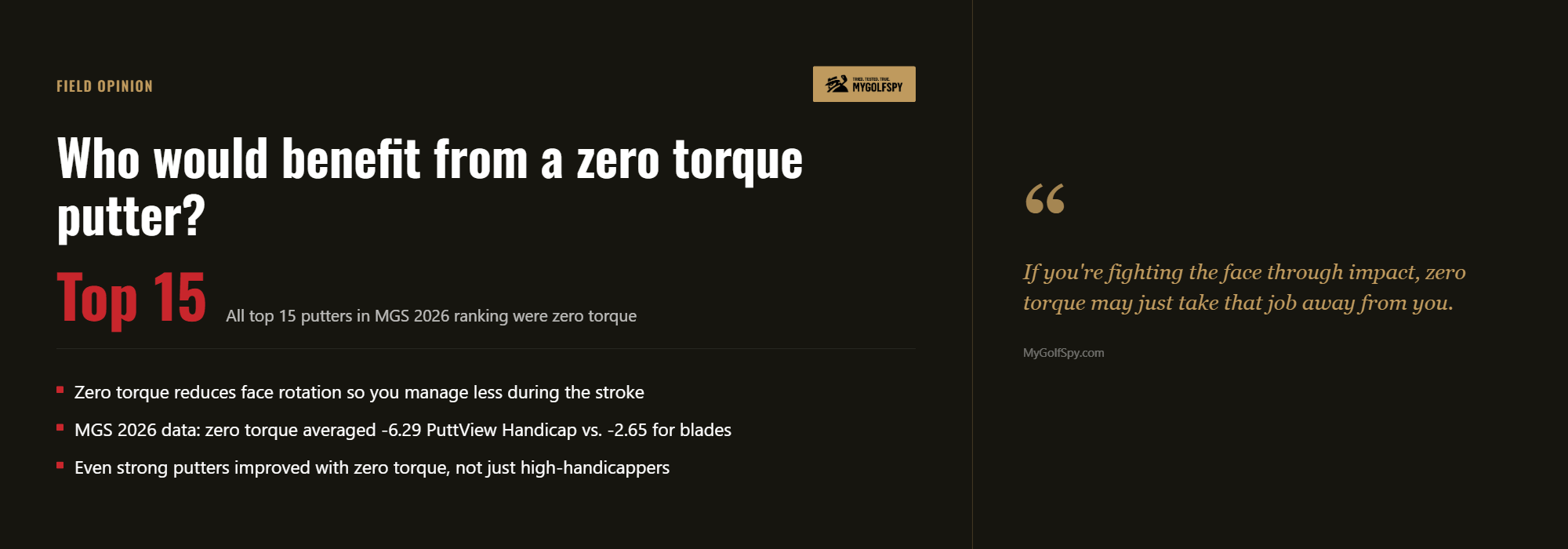
Our 2026 Most Wanted testing gives us a pretty good reason to ask. We tested more than 70 putters across the blade, mallet and zero torque categories. Zero torque averaged a -6.29 PuttView Handicap compared to -3.99 for mallets and -2.65 for blades.
When all 79 putters were combined into a single ranking, the top 15 were zero torque.
So what is zero torque helping golfers do and, just as importantly, is that something you need help with?
What is zero torque supposed to help with?
The simplest answer is face control.
With a traditional putter, the relationship between the shaft and the putter’s center of gravity creates torque that influences how the face wants to rotate during the stroke.
The golfer has to manage that rotation.
Zero torque putter designs position the shaft axis closer to the center of gravity so the putter has less tendency to twist open or closed on its own.
L.A.B. Golf describes its Lie Angle Balance technology as allowing the face to remain square to the natural arc of the stroke. Zero torque isn’t necessarily about creating a straight-back/straight-through stroke. Your putter can still travel on an arc. The goal is to reduce how much you have to manipulate the face while it does.
Since face angle at impact has such a large influence on where the ball starts, making the face easier to deliver consistently is the logical advantage to using a zero torque putter.

Who benefits the most from zero torque?
If you struggle with start direction, I’d test a zero torque putter. If you tend to leave the face open, get handsy or you know you can’t consistently start the ball where you want it to start it’s worth trying a zero torque putter.
That was what stood out when I switched from my Scotty Cameron to the Odyssey Ai-Dual S2S #7.
For about 20 years, I had learned what my Scotty wanted to do during the stroke and how much I needed to do to return the face to square. With the Odyssey, once I stopped trying to help it, the face felt much more stable.
The zero torque putter took some responsibility away from me.
For a golfer who feels like they have to time the release of the putter or actively manipulate the face through impact, that can be a big deal.
You don’t have to be a bad putter
One of the more interesting findings from our testing is that zero torque wasn’t just helping golfers who struggled. One of our better putters averaged a -8.26 PuttView Handicap with blades and -9.11 with mallets. With zero torque, he improved to -9.75.
Another strong putter went from -6.09 with blades to -10.97 with zero torque.
On the other end, one of our weaker putters averaged +4.55 with blades and +3.98 with mallets. His zero torque average was -0.97. Putting ability alone may not tell you if the zero torque category is for you.
The better question is how much work you are doing to get the face back to square and would you like some help with that.
But zero torque isn’t automatically better for everyone
My experience with the Technologist RP1 Pro helped me understand this side of the equation.
Before testing it, I wasn’t expecting much. Technologist intentionally isn’t trying to eliminate torque completely. Their Hyper Balanced VLT design retains some rotational response while trying to better control it.
And it performed really well for me.
I could feel the putter open and close naturally with my stroke but I didn’t have the feeling that I had to aggressively manipulate it back to square. In a way, I got a little bit of my job back and I liked that.
That experience is why I wouldn’t tell every golfer that the goal should be to eliminate as much torque as possible.
Some golfers like feeling the putter rotate. They use that feedback. They’ve spent years developing a stroke around it and they already return the face consistently.
What zero torque won’t fix
Zero torque solves a fairly specific problem. It makes controlling the orientation of the putter face easier. That doesn’t mean it’s going to fix every putting problem. If your aiming is off or you aren’t good at controlling speed and reading putts, it’s not going to help all that much.
There can certainly be secondary benefits. When I switched to the Odyssey, I felt like my strike became more consistent and my long-range distance control improved.
But I wouldn’t buy a zero torque putter if I was leaving 30 footers six feet short.
I would look at one if I was having trouble getting the face where I want it at impact.









Tom Marvin
3 weeks ago
Everybody would benefit from a straight back straight through putter. Why would you add a unnecessary variable of the arc back swing and arc forward swing. Straight back, clear and easy for the brain to understand, zero the putter face straight forward. Ball goes left you closed the face again, get a bigger grip. Do golf the easy way.