



Last month’s mailbag was a hit and you all kept the questions coming. Thanks to everyone who wrote in.
As always, I couldn’t get to every submission so I picked the ones that stood out most.
This month’s batch skews a little nerdier and I mean that as a compliment. We’ve got iron design, golf ball packaging and some pointed questions about how we run our testing here at MGS.
As a reminder, I do a new mailbag every month so send your submissions to me at [email protected] and you may be featured in the next one.
Pro golf, equipment, the MGS world … I will answer anything you want.
Without further delay, here are this month’s best submissions.
“Most recreational golfers, if asked what their favorite iron is (or which one they feel the most confident hitting), will typically reply 7- or 8-iron. Why then don’t manufacturers make an iron set where every iron is shaped like a 7- or 8-iron and the only variable is the loft and lie? It’s no wonder that golfers don’t like the longer irons since the surface area and shape of a 3- or 4-iron is so much smaller and more intimidating than a 7- or 8-iron.” — Kyle EricSon
Kyle, thanks for reading and love the question!
The technical answer is that, as loft decreases in a set of irons, you have to change the center of gravity and sole geometry to get the club to perform like a 3-, 4- or 5-iron. You need a lower CG to launch the ball at the trajectory of a low-lofted iron so the shape of the head changes to account for that. And when you get into wedges, the sole and bounce play a big role in turf interaction so the head changes in that way, too.
However, what you are describing is more or less the idea behind combo sets, hybrids/utility irons and game-improvement irons where longer clubs are made more visually appealing with larger clubheads. They have become popular for that exact reason.
There may be a sacrifice of speed but there is added forgiveness and the look at address provides a mental boost.
Another part of this is that a 4-iron is just farther away from your body than a 7-iron, right? And, unlike a driver, you don’t have a 460cc head on the other end.
Lastly, I think there is a psychological element where some players don’t want a long iron to look like a mid iron. Kind of ridiculous if you ask me but some players take a hit to their ego when playing a long iron that looks easier to hit.
“How about a really simple one: Golf balls should come in sleeves of four, numbered 1-4 in a sleeve. Most of us buy boxes anyway, so we’re still buying a dozen. Do we actually need sleeves if we are buying a dozen? We try to encourage golfers to be able to identify their balls, then we sell them identically numbered balls in a sleeve. Madness!” — Luke Collins
Luke, this is absolutely the kind of question I am here for. I wish we were at the 19th hole drinking a Modelo together.
Like so many things in golf, the three-ball sleeve comes down to a mix of practicality and old-school tradition.
Selling goods by the dozen long predates golf and for good reason: 12 is a special number because it splits evenly into groups of two, three, four and six.
So when golf balls shifted from hand-crafted featheries and gutta-percha balls to mass-produced rubber-core balls in the early 1900s, manufacturers needed a standard unit for sale. The dozen was the obvious choice and it has stuck ever since.
Once the dozen was the standard, the sleeve of three was a natural way to break it down. Four sleeves of three fill a box neatly and a single sleeve gives retailers a lower price point. That’s the impulse buy at the pro shop counter when you realize you’re down to your last ball.
But to answer your question more directly, three balls in a sleeve fit easily in a pocket or your hand whereas four balls in a sleeve becomes a little clunkier.
Could it have been two sleeves of six or three sleeves of four? Sure. Honestly, once shelves, boxes and shipping cartons were built around the three-ball sleeve, there wasn’t a compelling enough reason for anyone to change it.
As for the numbering, this is largely about manufacturing. The number stamp is one of the very last steps after balls are made in large batches. Printing and packing runs by number, one sleeve at a time. It is simpler and more efficient than sorting mixed numbers into every sleeve.
It’s worth noting that the old 1-through-4 system is already loosening up. Many brands now offer custom play numbers and premium models like TaylorMade’s TP5 let you choose double- or triple-digit numbers.
So why hasn’t anyone flipped to four-ball sleeves numbered 1 through 4? Mostly inertia. The current setup works well enough and changing it would mean redesigning packaging, retail displays and production lines for a problem most golfers solve with a Sharpie.
I would still love to see a brand get ultra-creative with packaging. As for numbering, I think customization will grow more prominent.
Remember, there is nothing in the Rules of Golf that says your ball needs to have a number. You just have to be able to identify it.
Emojis, custom graphics and all sorts of fun stuff will become more increasingly normal over time.
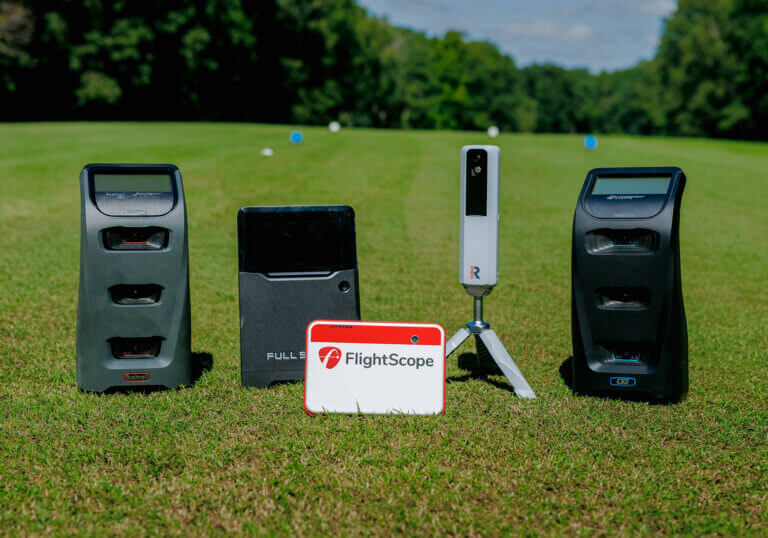
“Launch monitor testing: Can we test these monitors against reality? The current test puts them against the GCQuad. But have we tested any of them against the physical ball flight? All of the monitors use their own proprietary formulas to calculate ball flight characteristics. I see 40 yards of rollout on my drives frequently on a monitor, yet on the course I never seem to get any more than 10 yards. It might actually be a fun experiment to see how firm it would have to be to get 40 yards of rollout as the monitor predicts. If you find you need a cart path to get that, that’s valuable.” — Brendan
Brendan, I really appreciate the thorough questions (this one and three more below). I’ll do my absolute best to tackle these and hopefully the answers are satisfying. If they are not, please email me back ([email protected]) and we’ll fix it.
You’re right that our personal launch monitor testing uses GCQuad as the reference point, comparing each device based on average percentage difference. That is a comparison against the best available measurement rather than against the physical ball.
In our test of 12 launch monitors ranging from $500 to $5,000, ball speed was the most stable metric with most units staying within roughly one to two percent of our reference system. Carry is where things get murkier. Several models approached four- to five-percent deviation and those gaps usually came from small inconsistencies in launch angle and spin compounding into bigger carry differences. As Britt wrote in that piece, every launch monitor uses algorithms; the difference is how much it captures directly versus how much it has to estimate.
Your rollout observation is the key point and you’re not imagining it. Total distance is the most modeled number on any screen. As we noted in our Ball Test FAQ, a total distance number always relies on math to normalize ground conditions whether it comes from Trackman, Foresight or another algorithm. For the 2026 ball test, we used Trackman’s native bounce-and-roll algorithm which is built off firm, fast, PGA Tour-style conditions with an emphasis on roll. That’s exactly why we suggest cross-referencing total distance with carry, especially for irons and wedges.
To your original point, we have checked against physical ball flight in other tests before. In our 2023 ball test, we laid out a grid to spot the actual carry of each high-speed driver shot as it landed and then applied the USGA’s bounce-and-roll formula for total distance.
But you’re right that we haven’t done a dedicated launch monitor test against measured landing spots and rollout under documented turf firmness and green speed. It would require laying out a grid and having someone downrange in the landing area. This is potentially relevant for radar devices. Trackman would be the outdoor unit of choice for such a test.
“MyGolfSpy constantly expresses the importance of getting fit. So can we do a clubhead-only test instead of the off-the-rack test? Eliminate the variables in the fairway and driver tests by using the same shaft and shaft length in each club. Callaway has 3-woods a quarter-inch longer than other OEMs, and they vary even more in drivers. I’d love to see either a test where all variables remain the same besides the clubhead, or a smaller test where a smaller pool of people use their gamer shafts in all of the different clubheads.” — Brendan
We conducted a small test on this in 2024. Basically, we took a player’s iron (blade) and a game-improvement iron and compared them head-to-head off the rack.
The one variable we wanted to isolate was the clubhead itself. Each iron was built identically as possible minus the clubhead.
Interestingly, we found that the game-improvement iron was longer than the blade while the blade produced more spin and a tighter shot pattern. When the clubs were rebuilt to the same loft and specifications, the game-improvement iron remained longer and became more playable, putting the emphasis on finding the right loft for your swing rather than choosing by iron category alone.
That said, we acknowledge the limitation you’re describing. One of our takeaways from the 2026 driver test was that not all manufacturers invest equally in their stock shaft lineups. Even for off-the-rack buyers, a deeper shaft lineup is an advantage.
We also flagged the length issue you raised: the industry still can’t agree on how to measure an inch so one manufacturer’s 45.75 is often another’s 46.
“I love the ball quality control you guys test. Can we apply that to some golf clubs? I bought a driver two years ago, got fit for it and was hitting it great during the fitting. I put the order in, received it and could never find that fitting-day magic after that. I got its loft checked and the one I received was over 1.5 degrees less than the stated loft, and we had determined during the fitting my ideal setting was reducing the loft even further. I’d love to see head weight and actual loft data.” — Brendan
To a certain degree, yes.
We have the means to check a few particulars such as driver loft. In the past, we’ve included total weight, swing weight, playing length, loft and lie for several of our golf club categories. We can attest that just because products have “stock” specs, it doesn’t necessarily mean they meet those specs. Always check your lofts and lie angles.
Back in 2013, we measured more than 100 drivers on Mitchell loft and lie machines. Companies missed their stamped loft 92 percent of the time and over 16 percent of the drivers were off by two degrees or more. Most missed in one direction, though. Only seven of 105 drivers had less loft than advertised which makes your driver coming in 1.5 degrees under spec unusual.
While that was over a decade ago, the advice from that study still holds: if you were fitted with a demo club, insist on testing the actual club you’re buying before you pay for it.
“Posting all of the club and ball test data would help. Then numbers people like myself could create our own useful datasets, and I’m sure you’d see some interesting results you never would have thought of. For the driver and ball tests, I’d like to see the pools of players in more clubhead speed groups, maybe separated by 5 mph, as well as high-, mid- and low-spin players. I’d also love to see strike location and face angle posted. You take a ton of data, and at some point more data points aren’t providing meaningful information. You could scale back the major tests to collect more refined data. Posting distributions over averages would be helpful (10th, 25th, 75th and 90th percentiles), as would dispersion ellipses. I like the strokes gained approach, but there’s much more in the data than that.” — Brendan
There may be more accessibility to the data moving forward. We’ll be in touch with any updates on that front.
At the moment, the driver test publishes average ball speed, carry, total distance and backspin for every model and we follow up with separate rankings for slow, mid and high swing speeds. On the ball side, our Golf Ball Selector puts all the 2026 test data into a sortable tool, with driver speeds of roughly 116, 102 and 86 mph.
We also changed how we handle outliers this year. Because one goal was meaningful dispersion data, we didn’t remove outliers as we had in the past; atypical flights were flagged and re-hit and only non-reproducible or misread shots were dropped.
Our driver scores are built on Efficiency Values which remove ball and clubhead data outliers to give a cleaner representation than raw averages. Our forgiveness metric uses the gap between the longest and shortest carries, the fastest and slowest ball speeds, and total shot area.
We’re always looking to improve how we present the data, so we appreciate the questions!
“My question is about putter testing. I love the ball test and look forward to it every time. How do you guys work with the infinite number of options with the putters you have at your disposal to make sure the data is meaningful to readers?
Regardless of putter style, there are so many variables between alignment lines, neck options, lie angles, etc. You could hand a slant-neck Spider Tour X to someone who would perform significantly better with a face-balanced double bend, and they may struggle a bit, but as far as I can tell it’ll simply be recorded as ‘Spider Tour X.’ To then take that data and publish it to the masses for interpretation seems risky to the consumer and OEM.
The ball test makes sense: a robot hitting balls, with weather being the main confounding factor aside from the balls themselves. Even irons or woods have less nuance from model to model, even if you change shafts. Putters, however, are highly personal and player-dependent across an infinite amount of options catering to so many different strokes and visual needs. I’m curious how you guys control those variables to ensure the data collected is actually worth publishing.” — Jim S.
This is a great question.
Our testing takes time and putter testing would take forever if we included every available model. Our team knows presence is important but we must account for the time required to execute testing.
Therefore, to ensure proper representation, we’ve settled on including up to two models per manufacturer across blade, mallet and zero-torque putter categories.
The controls are aimed at making the comparison repeatable. In the 2026 mallet test, 20 golfers each hit 32 putts with each of the 29 off-the-rack models. Off-the-rack is used for all Most Wanted because it suits the highest number of golfers.
Your Spider Tour X example is a valid concern: a poor result with one neck should not be read as proof that a different neck would fail for that golfer. In our eyes, the most useful interpretation of the putter test is “these tested configurations performed this way across these golfers,” not “this model will perform this way for you.”
The putter test is meant to help golfers identify potential candidates and then get fitted to see what works for your stroke.
So that is all I have for the September mailbag!
Remember, send your questions to [email protected] and they could be included in the October mailbag.








Leave A Reply