


We’ve said it before and we’ll say it again here and now.
If Karsten Solheim isn’t on your Mount Rushmore of golf, I suggest you seriously reflect on your decision-making and find where you went wrong.
It doesn’t matter what brand of golf equipment you’re playing; PING’s DNA is in there somewhere. Most of the technology we see OEMs building upon today, whether it’s low CG, perimeter weighting, spin control or maximum MOI, can be traced back to the man who founded PING in his garage in 1959.
“He just had a different approach,” PING Engineering VP Paul Wood tells MyGolfSpy. “He was an engineer rather than a craftsman, an engineer who thought, ‘How do I help people? How do I build a better mousetrap?’”

That aura remains at PING’s Scottsdale, Ariz., headquarters to this day. PING employees will say they still feel Solheim’s presence, nearly a quarter of a century after his passing.
It’s fair of you to ask whether that’s real or just another case of corporate mythmaking. We put on our cynical journalist hardhat and decided to take a look for ourselves.
What makes PING PING?
PING remains a family business, making it an anomaly in today’s golf equipment world. Karsten’s youngest son, John A. Solheim, took over in 1995. John A.’s oldest son, John K. Solheim, was named CEO in 2022.
Wood, a 20-year PING veteran, has been Engineering VP since 2015.
“Being a family company, that engineering spirit is very much alive,” he says. “John A. was with his dad building putters in their garage in 1959. He’s still here every week.”

John A. is 78. John K., a Summa Cum Laude Arizona State University engineering graduate, is nearing 50. Both of them, plus John A.’s niece (and Karsten’s granddaughter) Stacy Solheim Pawels, meet with the engineering team regularly and, in Woods’ words, “go over every little thing.”
“Our conversations are all about how we can make our clubs perform better. Then we look at making a reasonable margin, selling it and all that other stuff. But it always starts with finding a better way to help a golfer get the ball in the hole quicker.”
The cynical golf journalist will tell you every OEM will deliver a similar message. PING, however, is the only one that will sit you down to discuss how its proprietary heat treatment method will reset the molecular structure of 17-4 stainless steel to give it performance characteristics it didn’t have before.
You won’t be the only one who’ll find it fascinating.

“In most companies, when you try to explain the intricacies of heat treatment to the executive teams, they’re like, ‘Why are you telling me this?'” says Wood. “John A. and John K. really want to know the details. John A. can talk more intelligently about heat treatment than I can because we have our own foundry and he has decades of live experience.”
The PING wedge saga makes PING PING
If your design benchmark is to make the next generation of golf clubs demonstrably better-performing than the last one, some clubs are more challenging to quantify than others.
“With drivers, it’s easier,” says Wood. “We can all agree that if ball speed goes up, it’s better. Wedges are more of a challenge since there’s so much more of a human element.”

Several years ago, PING made a concerted effort to improve its wedges. Not that its wedges were bad but they were perhaps the weakest link in the PING lineup. However, rather than simply saying “make a better wedge,” PING did a very PING thing. It defined what better wedge performance actually means.
“In the purest sense, ‘better’ means your handicap is coming down,” Wood explains. “’Better’ is your Strokes Gained around the green is improving, your up-and-down percentage is up.”
In one sense, that’s easy. The hard part is that pesky human element.
“It can all depend on what side of the bed you got up on that day,” says Wood. “Did I just blade my first chip across the green and it’s going to ruin my day? It’s hard to see the signal above the noise.

“We can do a 20-player test but there are so many human pieces in there that sometimes you look at the results and go, ‘This looks like a mess.’ We do plenty of tests that have no results at all.”
Once it defined “better,” PING’s engineering team needed to determine the ingredients, test procedures and measurables. It came down to two key components: spin and turf interaction.
Hydrophobicity makes PING PING
PING’s first wedge performance ingredient is spin. Or, more accurately, predictably high spin.
“If you have more spin potential, you’ll have more choices as a golfer,” says Wood. “If you have more spin predictability, you can play a shot and have more faith in it.”
Spin potential is a groove, face-milling and face-blasting story. Spin predictability is a hydrophobicity story.
When PING talks about wedge hydrophobicity, it literally means making the wedge water-phobic.
“Even before my time started at PING, we’d do wet/dry testing with our PING Man robot,” says Wood. “We knew dry testing off a tee would give you idealized conditions. I don’t know if Karsten or someone else on the team came up with the wet grass idea but we’d spritz some water on the club and ball and see what would happen.”
What happened was that spin went down. A lot. Throw some wet grass in there and spin went down even more.
“For the longest time, we’ve been trying to make those three conditions – dry, wet, and wet and grassy – to be as similar as we can.”

Measuring water beads makes PING PING
PING found the solution in a combination of groove geometry and coatings.
“We dug into it with our metallurgists,” explains Wood. “We found that with certain shapes of surface, we could create hydrophobic coatings, sort of like your non-stick Teflon pan at home.”
And PING, being PING, actually developed tests to measure just how hydrophobic its hydrophobic coatings could be.

“We put a drop of water on the surface and see what happens. If it spreads out and becomes like a film, that’s hydrophilic. If it beads up and you can actually see the beads, it’s hydrophobic. We can quantify this under a microscope by measuring the angle of the water bead.”
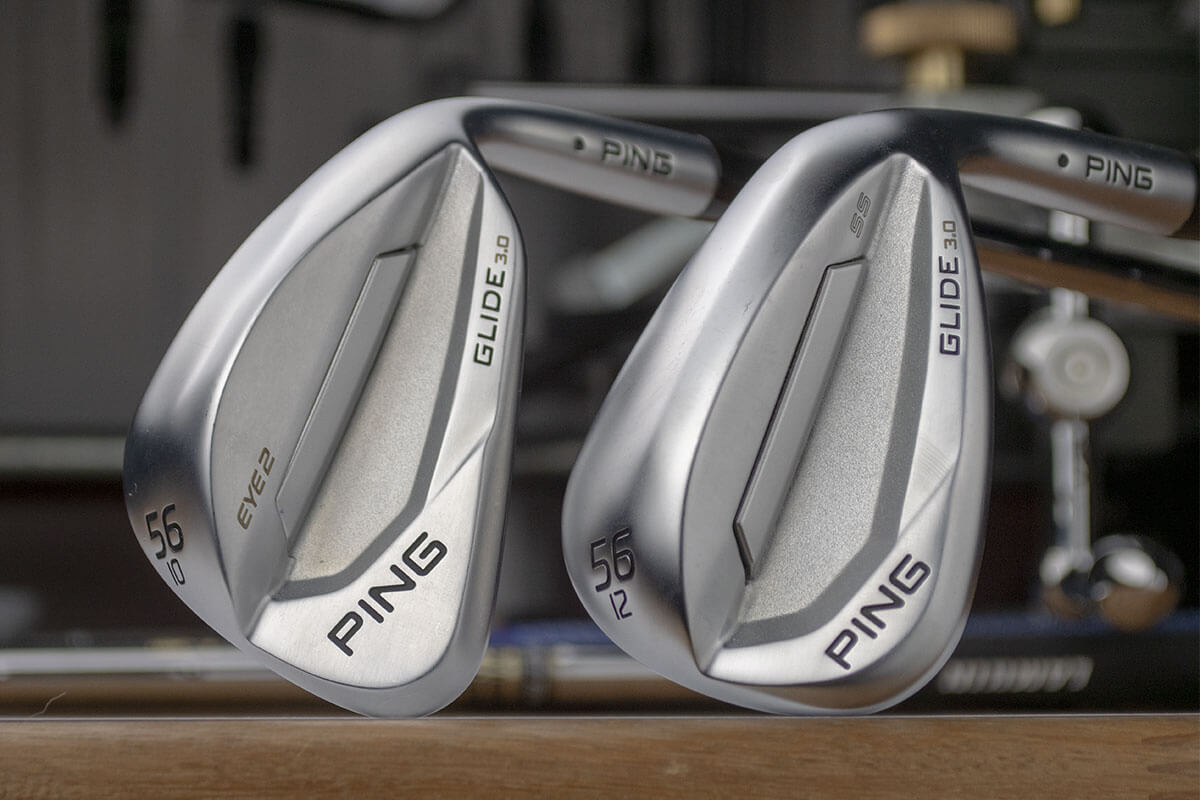
PING first introduced its hydrophobic finish, Hydropearl, in 2015 with its Glide wedges. MyGolfSpy started wet wedge testing in 2019 and the PING Glide 3.0 was the top wet performer, losing only 10 percent of its dry spin while others were losing 30 to 60 percent.
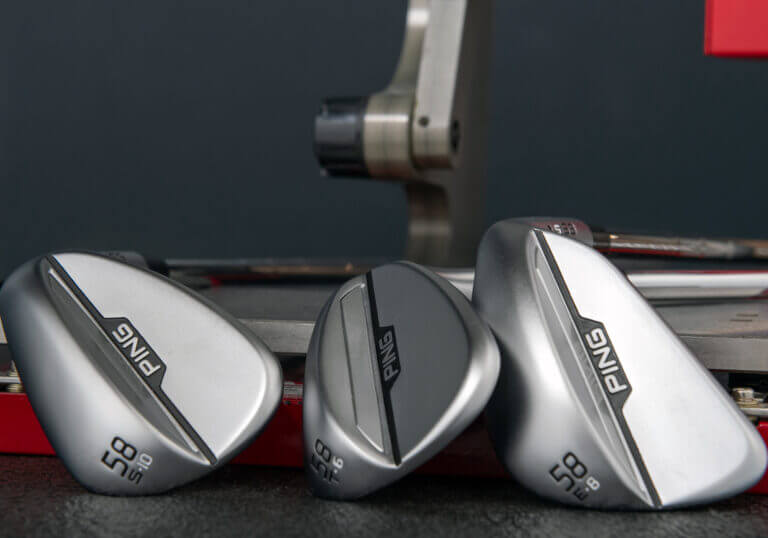
In 2021, many OEMs significantly improved their wet spin retention but the PING Glide Forged shocked us by actually picking up five percent more spin when wet. Just this year, the new PING S159 wedge copped top honors in our annual testing with improved accuracy and consistency to go with best-in-class spin performance, dry or wet.

The archer/arrow debate makes PING PING
If you believe it’s the archer, not the arrow, you should probably amend your analogy. It’s more accurate to say it’s the archer, not the bow. The arrow is more analogous to the ball than the club.
Either way, it’s a dismissive and inaccurate platitude. No, new equipment won’t fix your swing but the right equipment works with you rather than against you. And the next time you watch archery at the Olympics, notice the archers have really nice and expensive-looking bows.
Just saying.

“If I give you a driver and you hit two or three shots that go way right, you’re going to say there’s something about this driver that makes it go right,” says Wood. “If I give you a wedge and you hit a couple of terrible shots with it, your tendency is to say that wasn’t the wedge, that was me.”
The reality is it’s probably a mix of both. If you make a perfect swing, all wedges will do great. The club that works best for you, however, is the one that makes the result of your less-than-good swings playable.
“The archer/arrow thing is real for people so we have to work through that,” Wood says. “Understand that we can all hit one bad shot. But if it’s a pattern, that’s the wedge not working for you.”

That’s when bounces and grinds become important. PING added some new grinds to the s159 lineup and has refined its online wedge fitting app to help golfers sift through the noise to find the best wedges to demo based on the information they input. It doesn’t take the place of a live in-person wedge fitting but it at least takes the guesswork out of choosing a wedge.
“No such thing as standard turf” makes PING PING
The new PING s159 wedge series features six total grinds but Woods says the vast majority of golfers fit into three or four of those grinds with no problem.
“In our fittings, four grinds do the heavy lifting. We needed more options for our Tour players and for elite players. Six grinds is enough for us. Any more than that would be on the verge of getting really complicated.”

Wedge fitting is complicated and Woods admits PING’s fitting protocols have evolved over the past several years.
“We’ve done a lot on trying to model how you deliver your club but modeling turf interaction is difficult because grass is complicated stuff. It’s very different in Pinehurst compared to Seattle. There’s no such thing as ‘standard turf.’”
A PING wedge fitting nowadays doesn’t let you get comfortable. The fitter will have you hit a few full shots on the range, ask you a few questions and bring you to the green to try some grinds.

“We put you into different scenarios and say, ‘Hit this shot to that hole,’” says Wood. “You get one go at it, then you move to a different shot. We’ll go around the green a couple of times and won’t let you settle on one shot. Then you go into the bunker.
“If we leave you to your own devices, you’re not going to pick a shot you don’t like playing. You’ll pick something you like playing. What we need is the wedge that helps you on the shots you don’t like playing. You need to be a little bit uncomfortable.”
The 4,000-shot test makes PING PING
PING has recently upgraded its motion capture system to better capture partial shots. After all, a 20-yard pitch looks very different compared to a full iron or driver swing. The reason? PING wanted more data on how the ground impacts the swing and, by extension, contact.
PING tested 150 golfers on the new system, hitting more than 4,000 shots to see how much the ground impacts what the ball sees in terms of attack angle, club speed and impact location.

“We found that 86 percent of those 4,000 shots had some level of ground contact before ball contact,” explains Wood. “It sounds like we’re saying 86 percent of the people chunk it but that’s not quite true. You’re brushing the turf maybe a half inch before the ball. It’s still a good shot but the ground is part of the equation.
“You might have a steep technique but if you just brush the ground slightly before hitting the ball, you might lose a lot of that force by the time you get to the ball because the ground is a pretty big force pushing back.”
PING uses this data not only to refine its bounce and grind offerings further but also to refine its online wedge fitting tool. Once the algorithms determine a couple of options for you, it’s up to the golfer to see what might work best.

“I can give you a wedge that absolutely sucks for you but by your third or fourth shot you’ll sort of figure out how to make it work, especially if you’re a good player,” says Wood. “But on the course, you don’t get the best eight out of 10, do you? You get one go and you move on.”
The family thing makes PING PING
It’s interesting to wonder what Karsten would think of AI, motion capture systems and modern data collection. My only guess is that, as an engineer, he’d embrace it to make clubs better.
“I never got to see him putt,” says Wood. “But the story goes that he was not a very good putter so he had to find a better way.”
That led to the PING 1A, the putter that really did go “ping.”
You can also be assured that how other OEMs use modern technology would not influence Karsten one bit. By all accounts, he was the living embodiment of Sinatra’s “My Way.”
“Growing up, I was told there was the right way, the wrong way and Karsten’s way,” David Solheim, John A.’s youngest son, told Family Business Magazine in 2008. “When you start up your own company, you can tell people the way you want things done. It’s been a while since he was here but that idea has not left this place.”

“We don’t come out with many duds because it’s always about performance,” says Wood. “There’s never any pressure to launch something because of a cool marketing feature. If it doesn’t work or it isn’t better, it’s not going in.
“If that means the product isn’t quite as exciting, so be it.”









Joe Perez
2 years ago
What sold me on Ping’s wedges (Glide series) was a slightly lower swingweight than I measured in other wedges. The Glide2.0 wedges were measuring at least one “point” below others (D3.0 as opposed D4.0). When Phil Rogers invented the original Trusty Rusty sand wedge, he designed it with a lighter swingweight because he found that recreational players had trouble with the heavier swingweight of other manufacturer’s sand wedges. As a recreational player, I couldn’t agree more.