


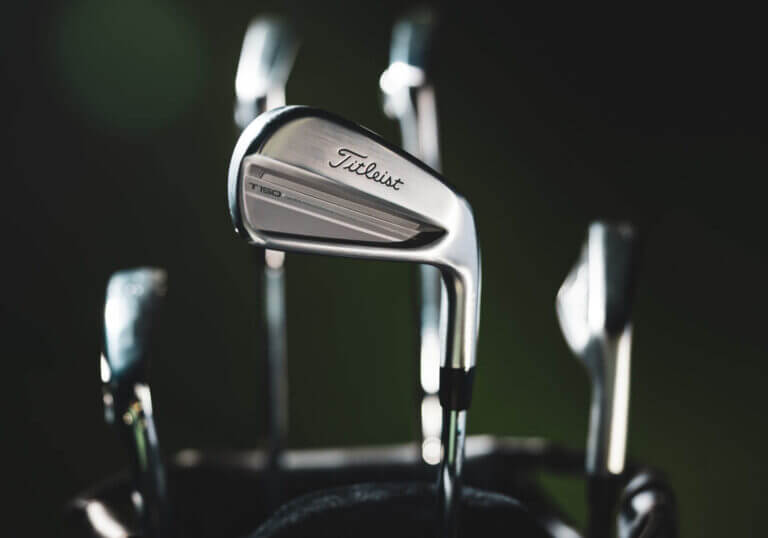
Both the Srixon ZXi7 and the Titleist T150 are built for the same type of golfer. If you prioritize feel and workability, don’t need extra help getting the ball in the air and are willing to trade some forgiveness for a cleaner, more blade-adjacent look, both of these irons should be on your list.
Which one performs better? We ran both through the 2026 Most Wanted Player’s Iron test with 20 testers and the results are worth unpacking. The answer isn’t as simple as one being better than the other.
Where the numbers are basically the same
Let’s start with what the data doesn’t show because that’s relevant.
Directional accuracy is a wash. The T150 averaged 7.61 yards from center; the ZXi7 7.58. Playable rate was 98.4 percent versus 97.8. Neither iron is meaningfully more accurate than the other across our tester population. If you’re choosing between these clubs based on which one goes straighter, you’ll have a hard time seeing much of a difference.
Spin is nearly identical. T150 averaged 5,685 rpm; ZXi7 5,728.
Strokes Gained is essentially tied. Both irons came in at 0.38 SG (adjusted) when averaged across the full tester group. Head-to-head across 20 individual matchups, the T150 won SG in 12 of 20, the ZXi7 in eight. A slight edge for the T150.
The honest summary: These are two very good player’s irons that perform at a similar level in some of our measured categories.
Where the differences showed up
GIR: The ZXi7 finds more greens—especially as you go shorter
In overall GIR across all 20 testers, the ZXi7 averaged 59.2 percent compared to 55.8 for the T150, winning 12 of 20 head-to-head matchups. But the aggregate number only tells part of the story.
When we break it down by the individual irons we tested (5-iron, 7-iron, pitching wedge), the T150 leads in the 5-iron at 90.0 percent greens in regulation versus 86.9 for the ZXi7. The gap flips in the 7-iron and by the time you get to the pitching wedge, the ZXi7 hits 100 percent GIR while the T150 finishes last in the field at 97.4.

Ball striking: The T150 rewards good contact more
The T150 generated a higher smash factor and slightly more carry (165.5 versus 164.2 yards). Its shot area—a measure of dispersion tightness—was 5,071 square feet compared to the ZXi7’s 5,431. When the T150 is struck well, it tends to be a little more efficient with the energy transfer.
This lines up with the Strokes Gained edge. The T150 squeezes a bit more performance out of quality strikes. The ZXi7 spreads its performance a little more evenly.
Does swing speed change anything?
We segmented testers into three groups (slower (<82 mph), mid (82–87 mph) and faster (87+ mph)) to see if the gap between the two irons shifted at different swing speeds.
The ZXi7’s GIR advantage was largest among slower swing-speed testers and mid-speed testers and smallest among faster testers.
The T150 had its strongest individual performances among the highest-swing-speed testers. At 100 mph, one tester hit 19.5 percent more greens with the T150. At 91 mph, another hit 15.4 percent more greens with the T150.
How they finished in the full field
In the 15-iron Most Wanted Player’s category, the T150 ranked second and the ZXi7 fifth. Both finished well above the field average in SG and GIR. The gap between them in the final standings not wide. The T150’s efficiency edge on pure contact was enough to move it up the leaderboard.
Final thoughts
The T150 is the slightly more efficient ball-striker of the two. It generates better smash on pure contact, tighter dispersion, and won the SG battle in head-to-head testing more often than not. If you tend to hit it flush and want to maximize what happens when you do, the T150 has a case.
The ZXi7 found more greens across a wider range of testers and swing speeds. Its GIR advantage was consistent and it showed up at slower swing speeds as much as faster ones. If getting the ball on the green is the priority, the ZXi7 earned that result across our tester group.
Here’s a look at our complete player’s iron test results: Best Player’s Irons 2026.




Jim R
3 months ago
I like the T150 having 4deg loft gaps in the lofted irons (ZXi7 is 5deg) as that’s what works for my yardage gaps. The T150 has a TT AMT Silver vs the ZXi7 with a DG Mid 115. With these clubs so close to each other in performance, we might be seeing the shafts causing the differences??? MGS should start including a description of the shafts being used.