
The Sneaky Hack To Hit Every Green (And It Only Takes 20 Minutes)
News

The Sneaky Hack To Hit Every Green (And It Only Takes 20 Minutes)

Support our Mission. We independently test each product we recommend. When you buy through our links, we may earn a commission.

The Sneaky Hack To Hit Every Green (And It Only Takes 20 Minutes)

You’re standing over a 68-yard shot and know exactly what to do. Not because you’ve played for 30 years or because you have a swing coach on speed dial but because you’ve done the work to know your own numbers.

Most golfers haven’t. And it’s costing them strokes they don’t even realize they’re giving away. I love playing golf based around feel and what seems natural but that comes after you’ve learned what yardages you’re capable of.

Feel is real—but it needs a foundation

Ask most golfers how they decide what to hit from inside 100 yards and you’ll get some version of the same answer: feel. The best wedge players in the world talk about feel constantly.

But here’s the thing about feel: it only works when it’s calibrated to something real.

When a tour player says they “felt” a 72-yard shot perfectly, they’re working from years of verified data in their body. They’ve hit that shot hundreds of times with a known result. Their feel has a reference point.

Most amateur golfers are working from feel with no reference point at all. Creating your wedge distance chart or matrix fixes that.

What you need to know before you start

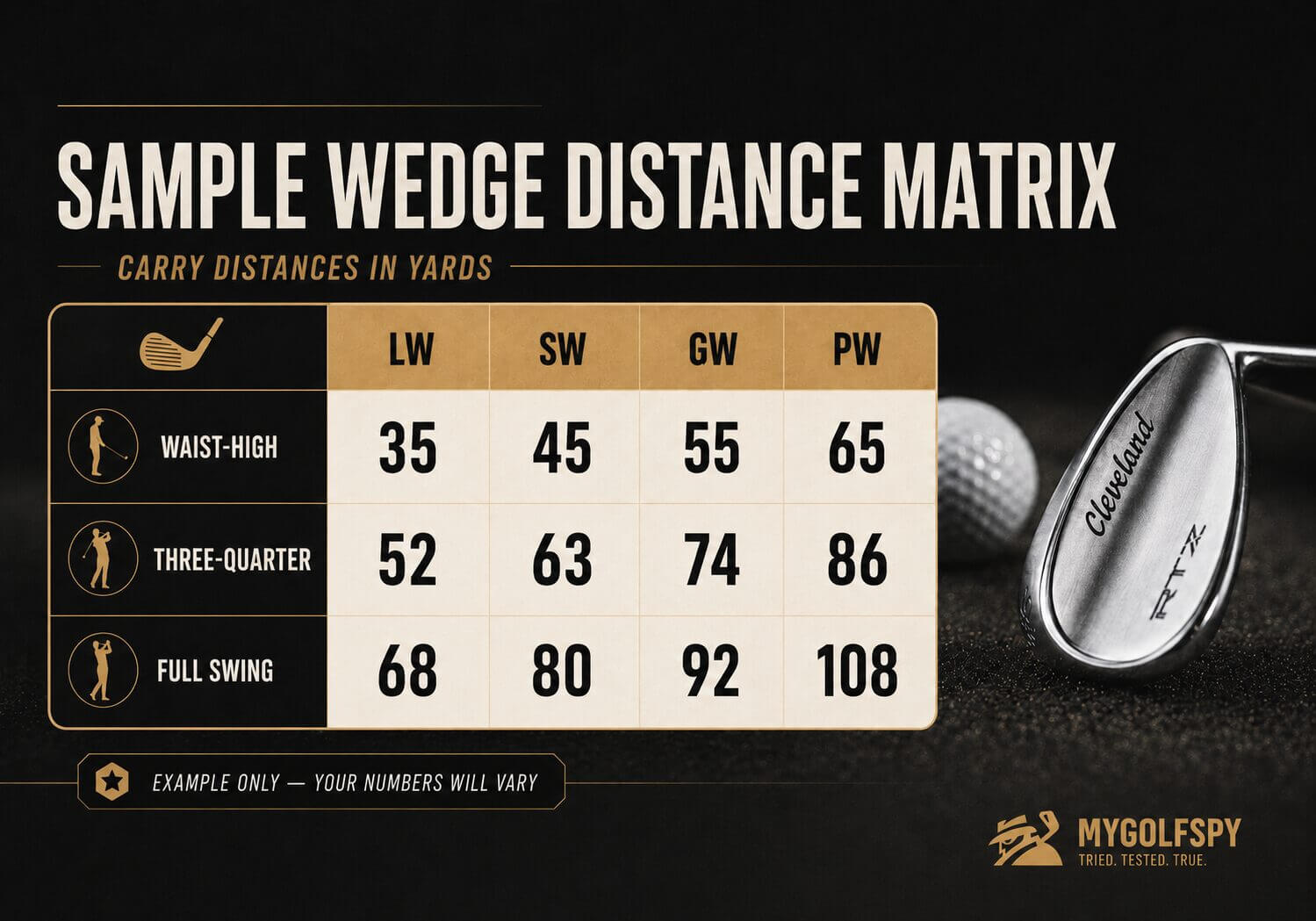
A wedge distance chart (sometimes called a wedge matrix) maps your carry distances across every wedge in your bag at three different swing lengths. With three swings per club and three to four clubs in most bags, you’ll have between nine and 12 distinct carry distances covering the entire scoring zone.

A few things to have sorted before you hit your first shot:

Swing like you’re on the course. The whole point is to measure the swing you have, not your best range swing.

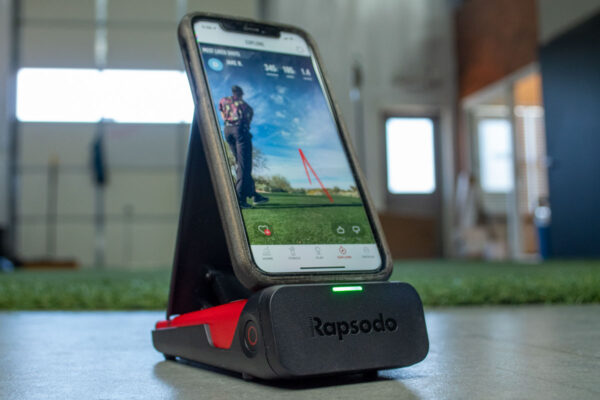
You need a launch monitor or simulator. A rangefinder gives you total distance. A launch monitor gives you carry.

Bring every wedge in your bag. Most golfers carry three or four: pitching wedge, gap wedge, sand wedge and sometimes a lob wedge.

The three swings

You’re going to use three swing lengths for every club.

Waist-high: Club goes back to hip height, follows through to hip height on the other side. Backswing and follow-through match in length. This swing sometimes feels uncomfortably short when you first try it. That’s fine, stick with it.

Three-quarter: Lead arm swings back to roughly 9 o’clock—level with the ground, across your chest. It’s the hardest of the three to find consistently which is actually a good reason to practice it deliberately.

Full swing: Your normal full swing, not your hardest swing. There’s a Ben Hogan quote that gets passed around that’s relevant here. He’d love to play the guy who hits his wedges full out for money. Tempo wins here. A controlled full swing with a wedge will give you tighter distance windows than a full-send swing.

Recording the distances

Work through one club at a time. Start with your highest-lofted wedge and work up to your pitching wedge.

For each swing length, hit three shots. Average the carry distances and write it down. That’s your number.

A few honest notes on the process:

If you chunk one or skull one, throw it out. A complete mishit doesn’t represent your real carry distance any more than a perfect one does.

If you hit one that goes 22 yards and one that goes 31 yards and one that goes 26 yards, the average is 26. That’s your number. Don’t round up or chase clean numbers.
What to do with the data

Once you’ve filled in your numbers, lay them out from lowest to highest and look for two things: gaps and overlaps.

  • Gaps are dead zones: distances you’re regularly faced with but don’t have a rehearsed answer for. A cluster between 55–60 yards with nothing until 85 is a scoring problem.
  • Overlaps mean two clubs or swing lengths are competing for the same distance. That’s either a tempo issue (swinging too hard with one, too soft with another) or a loft gap problem.
  • Outliers are worth a second look, too. If one number doesn’t fit the pattern around it, that’s usually a technique issue worth taking to the range.

How to use this on the course

Once you have completed your chart, start using it on the course. Some players write the three distances for each wedge on a sticky note and put it on that club shaft. It could also be a note on your phone that you look at before you tee off.

When you get used to incorporating this into your routine, your feel will get better. Instead of standing over a 68-yard shot with a vague sense of unease, you’re standing over it knowing you’ve hit this exact shot before. Your body has a reference. Your feel has something to calibrate against.

Final thoughts

As your swing changes, your numbers will shift. Take some time at the range to update your wedge distance chart once or twice a year or whenever you make a swing change.

For You

For You

We Tried It
Jul 7, 2026
3 Easy Summer Golf Looks For Women Who Play In The Heat
News
Jul 7, 2026
Golf Terms: 100+ Words Every Golfer Should Know
PING founder Karsten Solheim with son John A. Solheim PING founder Karsten Solheim with son John A. Solheim
News
Jul 6, 2026
Did You Know PING Nearly Got Sold?
Brittany Olizarowicz

Brittany Olizarowicz

Brittany Olizarowicz

Britt Olizarowicz is a scratch golfer, former teaching professional and one of MyGolfSpy’s leading voices on equipment testing and golf performance. She has spent more than 15 years working at private clubs in New York and Florida and now specializes in translating test data and swing mechanics into practical advice for everyday golfers. Britt began playing at age 7 and has never left the game. When she’s not writing, you’ll find her on the course, playing pickleball, cooking, running or out on the boat with her family.

Brittany Olizarowicz

Brittany Olizarowicz

Brittany Olizarowicz


    This site is protected by reCAPTCHA and the Google Privacy Policy and Terms of Service apply.

      Sven

      1 month ago

      I’d suggest extending the chart into several short irons as well. You might find yourself needing a 60 yard pitch that goes only so high because there is a tree limb on your line that you need to stay under. Guesses rarely work out well.

      Reply

      Philly Ray in MN

      1 month ago

      This is a great exercise for every golfer, especially beginners since they don’t have their scoring clubs dialed in yet. Thanks for the article.

      Reply

      vito

      1 month ago

      I found that this will work if you use real golf balls, not “range” balls. My local range gets new balls every year. They are around 90 compression and have covers that are twice as thick and harder than most golf balls. Because of this the spin on wedge shots is 2000-3000 rpm lower than than tour balls and they launch lower and go farther. I checked this on a Trackman indoors. My pitching wedge with outdoor range balls will fly 125yds but on the course a perfect strike gets me 110.

      Reply

      Todd Early

      1 month ago

      May not be the exact Pelz Short Game Bible method, but same principles. I recommend Dave’s book for anyone looking to improve their short game.

      Reply

      00RynTinTin

      1 month ago

      Great article Britt. Scoring clubs are the secret sauce to breaking par. I love the Hogan quote.

      How does draw spin and fade spin work to determine overall distance in the wedge game.

      I love playing shaped shots….

      Thanks

      Reply

      Clayton

      1 month ago

      I’ve done this for years now & my SG Approach & handicap have improved significantly. I even have a printed out table of the matrix + total carry for each club in my bag based on BLP monitor data. I would also add that you can pretty consistently adjust a few yards here & there by choking down 1.5 inches on the grip and/or moving the ball slightly back to lower flight. This way if your 3/4 swing 54 goes 90 yards, you can also take off 3 by choking down & another 2 by flighting the ball lower. Now you have an 85 yard shot too.

      Reply

      Don Morrison

      1 month ago

      Great article.

      Reply

      JW

      1 month ago

      This is exactly the Dave Pelz system, something he wrote about decades ago. They teach this in his 3 day scoring schools.

      Reply

      Andrew the Great!

      1 month ago

      No, not exactly. Pelz taught the quarter, half, three-quarter, and full swing method. I read his Short Game Bible like it was a, well, a bible, and I started using his method in the ’90s and I still to this day carry a book in my back pocket, or have a plastic matrix attached to my bag, showing my Pelz distances (for every iron, not just the wedges). And I’ve changed it over the years as my clubs and my game have changed.

      But I like Brittany’s better, because I never, ever felt right with the quarter backswing. My quarter backswing never felt like the ball was gonna go anywhere, so I never swung it properly. (I probably actually swung it more than quarter, because instinctively I “knew” I had to.)

      I need to revamp my system to Brittany’s three swings, and whatever distance a quarter-swing was supposed to do, I can get with a half-swing (her waist high swing) but using a more lofted club.

      Reply

      KJC

      1 month ago

      This is sound advice. I have performed this analysis for every club in the bag. I have it written on a piece of paper and keep it in my tee bag. I did also add the total distance to each carry distance. I found that a 70 yard PW rolls out further than a 70 yard lob wedge as swing speed impacts spin rates. New wedges change the spin and total number as well. I also added punch shots, cuts and draws.

      Reply

    Leave A Reply

    required
    required
    required (your email address will not be published)

    This site uses Akismet to reduce spam. Learn how your comment data is processed.

    We Tried It
    Jul 7, 2026
    3 Easy Summer Golf Looks For Women Who Play In The Heat
    News
    Jul 7, 2026
    Golf Terms: 100+ Words Every Golfer Should Know
    PING founder Karsten Solheim with son John A. Solheim PING founder Karsten Solheim with son John A. Solheim
    News
    Jul 6, 2026
    Did You Know PING Nearly Got Sold?