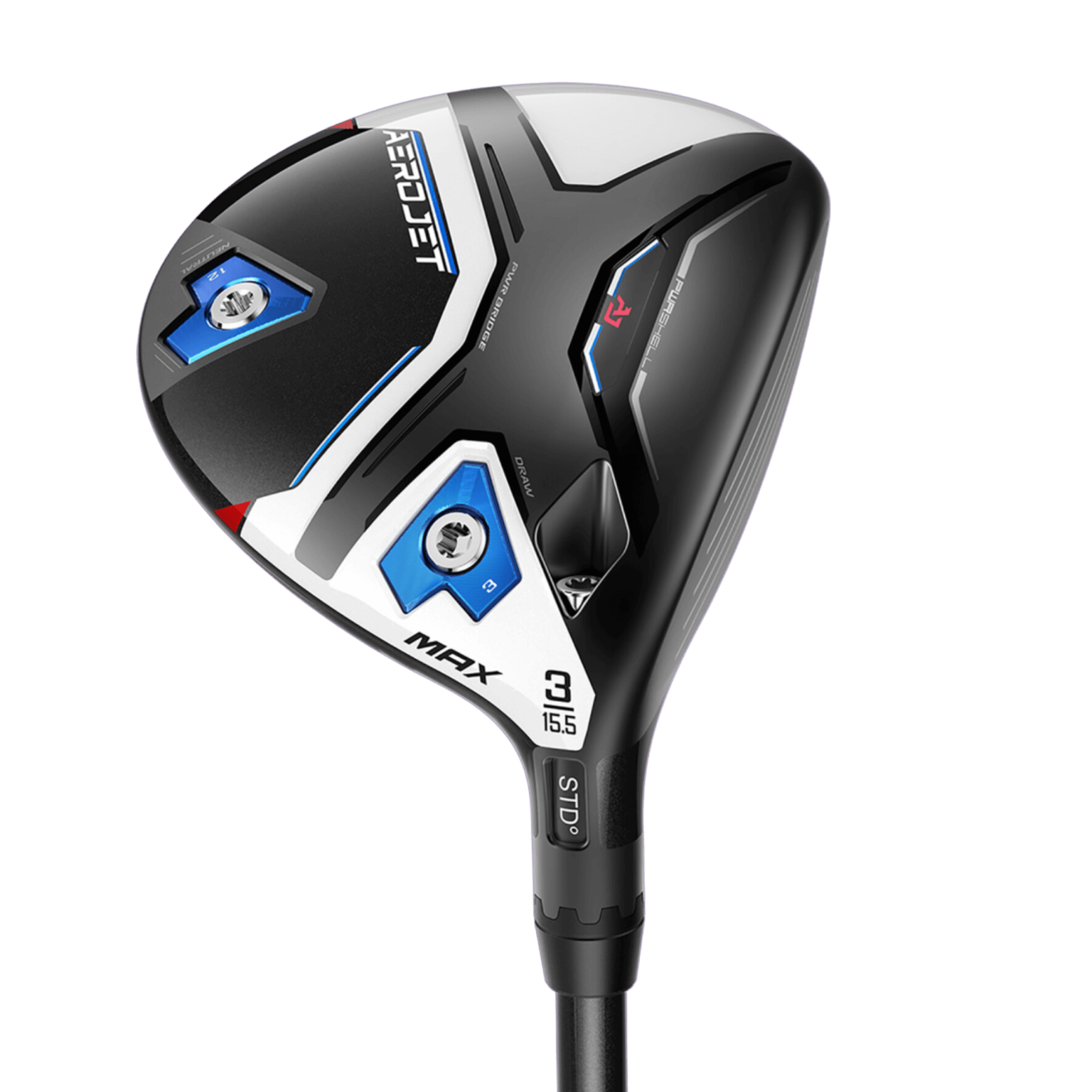
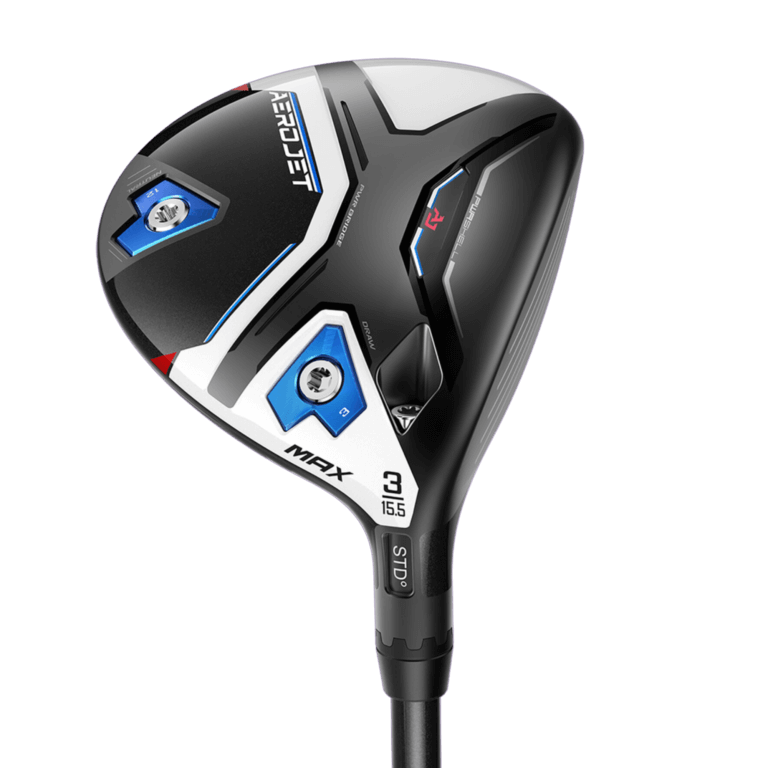
COBRA AeroJet Max fairway wood ranks 13th in our best fairway woods 2023. Accuracy and forgiveness are its two greatest strengths. For forgiveness, AeroJet Max fairway wood places 5th overall relative to the field. For accuracy, it narrowly misses out on the top 10 by finishing 12th.
By ranking 5th for forgiveness, COBRA AeroJet Max fairway wood demonstrates its main goal - offering consistent performance for a multitude of golfers. Forgiveness and accuracy should be a priority for most golfers, especially in a fairway wood.
COBRA AeroJet Max fairway wood has a below average score for distance. If distance is your goal, you might want to look at other fairway woods.
The Cobra AeroJet Max Fairway Wood is designed for golfers of all skill levels who prioritize forgiveness, versatility, and maximizing distance. It offers adjustable weight settings in the back and heel, allowing for a neutral or draw-biased flight. The innovative PWRBridge weight design creates flexibility in the face and sole, positioning the center of gravity lower and more forward for faster ball speeds. It is part of the Cobra AeroJet fairway wood line, which includes three models: a low-spin LS, a MAX forgiveness model, and a standard model that offers balanced performance.
 Distance
 Taking into account total distance and carry distance, our distance scoring is a metric ultimately telling you the total yards achieved by the club.
Details to come...
 Accuracy
 Accuracy evaluates if a player’s shots with each club are above or below what’s expected based on that player’s skill level. By eliminating variables in player ability, accuracy determines how well the club improves a player’s overall score.
Details to come...
 Forgiveness
 Forgiveness measures how well a club corrects for hits that are center or off center off the face of the club. A high forgiveness rating tells you that a club does well at maintaining consistency in performance when your swing fluctuates.
Details to come...
 Ball Speed
 Ball speed measures how fast the ball is traveling off the face of the club. We eliminate variables like player swing speed or ability, so you can compare ball speeds off the face as affected by the club, not the player.
Details to come...
 Fairways Hit
 We evaluate the percentage of shots that hit the fairway compared to shots in the rough. This shows the accuracy of a club, with a higher percentage earning a higher accuracy rating.
Details to come...
Answer a few questions about your swing, and we’ll match your game to our database of over 100,000 swings. With 97.8% of swings matched, we’ll recommend the top performing drivers that will give you the best results. Maximize your potential with advanced golf analytics powered by MyGolfSpy.
The speed at which the golf ball travels after being struck by the golf club. It is usually measured in miles per hour (mph).
Shot Area is a measure of downrage dispersion. The displayed value is the area of an ellipse (measured in yards2) in which 90% of future shots would be expected to fall.
The total distance the golf ball travels from the point of impact with the clubface to the point where it stops, including both carry distance and any additional roll after the ball lands.
The distance the golf ball travels through the air from the point of impact with the clubface to the point where it first touches the ground. Carry distance does not include any additional roll after the ball lands.
The amount of backspin or topspin on the golf ball after the club strikes it. Spin can affect how the ball travels through the air and how it behaves when it lands.
The angle at which the golf ball leaves the clubface after being struck. This is typically measured in degrees.
The highest point in the golf ball's trajectory after the club strikes it. This is typically measured in feet above the ground.
The angle at which the golf ball descends from the apex of its trajectory to the ground. This is typically measured in degrees.
This refers to the distance that a golf shot travels from the center of the fairway. It is often used to measure accuracy, with shots closer to the center considered more accurate.
Refers to the percentage of times a golfer successfully lands their tee shot on the fairway. It is often used as a measure of accuracy.


Our mission is #ConsumerFirst. We are here to help educate and empower golfers. We want you to get the most out of your money, time and performance. That means providing you with equipment reviews you can trust, as well as honest reporting on the latest issues affecting the game today. #PowerToThePlayer


| Driver Ping G30 | Hybrids PXG 0317 |
| 3/4 IRON PXG 0311XF | 5-GW Srixon Z 565 |
| SW PXG 0317 | LW PXG 0311 |
| Putter EVNROLL |
No comments yet. Start the discussion!








Leave A Reply