



In the minds of many golfers, conventional wisdom is that you want spin to be as low as possible when hitting a driver.
Launch it high with low spin, right? So the fastest swing speed golfers who are naturally able to launch the ball higher should find drivers that spin lower, right?
In the words of Lee Corso, “Not so fast, my friend.”
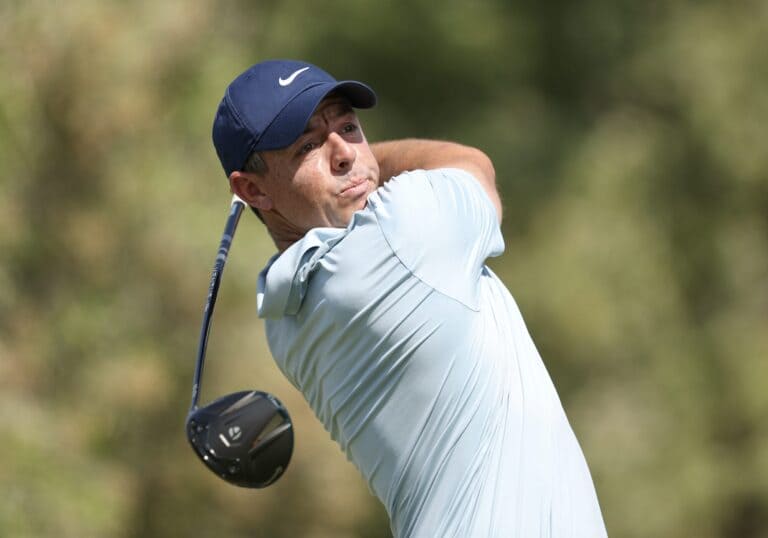
Rory McIlroy studied the TaylorMade Qi4D and Qi4D LS (which stands for “low spin”) before choosing the standard model. One priority in his fitting was avoiding unpredictably low spin.
Huh? He wants to avoid low spin? That’s right (I’ll explain in a moment).
That raises a reasonable question for the rest of us: If Rory can get what he needs from the standard head, what should convince an amateur (even a high swing speed player) to choose the LS?
Our testing provides an answer albeit with a few complications. The LS produced more distance for high-speed testers while the standard head scored better for accuracy and forgiveness in that group.
The choice comes down to the shots each head produces for you.
Said another way: playing the LS is not a swing-speed badge.
What Rory wanted from his driver
According to TaylorMade’s account of McIlroy’s fitting, spin falling below 2,000 rpm was a concern for him. He wanted a dependable spin window and fewer unexpectedly low-spin shots that were harder to control in terms of trajectory and shape.
In more concrete terms, McIlroy found the standard Qi4D head allowed for more curve where he wanted it—namely, hitting his famous towering draw out of the window he wanted. The LS sacrificed some of that shape.
The company credits improved spin stability and performance across mishits as reasons he trusted the Qi4D. His setup places the heavier pair of adjustable weights in the rear positions with lighter weights forward.
He was evaluating how reliably the driver performed including when contact varied.
The standard Qi4D can also produce relatively low spin. Choosing it doesn’t mean choosing a high-spin driver.
The standard model won our test
The Qi4D finished first overall in our 2026 Most Wanted Driver test which included 42 models and 20,580 shots.
It earned that through balanced performance (sixth for distance, fourth for accuracy, fourth for forgiveness). Its scores were 9.3 for distance, 9.2 for accuracy and 9.1 for forgiveness, contributing to a 9.2 overall score.
There was no need to accept a weak distance result to get the standard head’s other strengths.
Our forgiveness category also deserves an explanation. We assess variation in ball speed and carry distance along with shot area. The score reflects consistency in measured outcomes.
Rory’s choice and our test result come from separate evaluations. Together, they offer a reason to put the standard head into a fitting rather than assuming the LS is the inevitable destination for a high-swing-speed player.
Where the LS earned its place
Tommy Fleetwood provides a TaylorMade counterexample.
His February equipment listing featured a Qi4D LS with 10.5 degrees of loft and a Fujikura Ventus TR Blue 6 X shaft.
Fleetwood is not McIlroy with his driving stats. Rory finished second on Tour last season (330.3 yards per drive) while Fleetwood finished 100th on the nose (304.8 yards per drive), slightly below Tour average.
We shouldn’t guess why he selected it. For testers swinging at least 105 mph, the comparison looked like this:
| High-speed testing result | Qi4D | Qi4D LS |
| Carry distance | 277.08 yards | 279.77 yards |
| Total distance | 290.59 yards | 294.04 yards |
| Accuracy score | 9.4 | 9.0 |
| Forgiveness score | 9.1 | 8.7 |
| Overall score | 9.2 | 9.2 |
The LS added approximately 2.7 yards of carry and 3.5 yards of total distance, a small but meaningful difference that could be greater from player to player. The standard head scored better for accuracy and forgiveness. Both earned the same rounded overall score.
For a player who can use the additional distance while maintaining acceptable dispersion—Fleetwood ranked a very strong 23rd in accuracy last season—that is a valid reason to potentially favor the LS.
Interestingly, the LS averaged 2,398 rpm in this test group compared to 2,335 rpm for the standard head. The LS label didn’t guarantee the lowest measured spin average.
These are golfer-test results rather than a robot comparison holding every delivery variable constant so the human element is at play.
The advantage changed at other speeds
So what happens if it’s not a high swing speed golfer?
Among mid-speed testers, the distance gap essentially disappeared.
The standard Qi4D averaged 253.8 yards of total distance compared with 254.1 for the LS; we’re really splitting the width of a golf tee now.
Meanwhile, the standard head’s accuracy score was 9.7 versus 8.4 for the LS. The LS scored better for forgiveness, 9.3 versus 9.0, but the standard head earned the higher overall score: 9.3 versus 8.9.
That produces a different buying discussion from the high-speed results. In this group, choosing the LS didn’t deliver a meaningful average distance advantage.
At slow speeds, the standard head also finished ahead overall, 8.8 to 8.5 and averaged 199.5 yards of total distance versus 198.2 for the LS.
It’s worth reiterating that these are group averages so an individual fitting can produce a different result.
But the “LS goes farther” assumption is something that needs to be challenged.
Who should buy the low-spin model?
Who should buy the LS model of this driver?
The answer is the golfer who can demonstrate a benefit from it (sorry to be diplomatic).
If excessive spin is limiting your current flight, compare the LS with a properly fitted standard head. Judge the combination of launch, spin, carry, dispersion and consistency. A smaller spin number is useful when it improves the resulting shot.
Take Rory’s advice and don’t be a prisoner to the “lowest spin at all costs” thought.
A practical comparison should answer three questions.
- Does it improve your normal drive? Compare representative shots rather than selecting the longest ball from each club.
- What happens on your common miss? Include the strikes that usually cost you distance or position.
- Is the gain worth any tradeoff? Extra carry may justify a change. Wider dispersion or less reliable carry may change that calculation.
You also don’t need Rory’s speed to earn permission to try an LS head. Equally, having Tour-level speed doesn’t obligate you to choose one. The fitting has to establish the advantage.
Our results show that the LS offered a distance benefit in the high-speed group while the standard head provided the stronger overall result at mid and slow speeds.
Copy Rory’s question
Rory’s driver choice is a useful challenge to the idea that the fastest players automatically belong in the lowest-spin model.
It isn’t a reason to remove every LS driver from consideration. Fleetwood plays one and our testing found a distance advantage for the Qi4D LS among fast swingers.
The useful question is the one Rory’s fitting addressed: Which setup gives me the flight I want, reliably?
If the LS improves that result, it belongs in the conversation. If it only gives you a more appealing model name, keep testing.






Fake
41 seconds ago
I have a Cleveland HiBore XL that I set at 9 degrees because my old driver was fixed at 9 degrees. I really should tinker with it just to see what would happen. I always think it’s interesting when the pros play “high lofts”, as is the case with Fleetwood playing a 10.5 degree driver.