


A backswing does not become too long the moment the shaft passes parallel. Some golfers play very well from there. Others lose control of the club well before it reaches that point.
What matters is what you have to do to keep going back. If the last bit of your backswing requires you to loosen your grip, fold your arms sharply or tip out of balance, that extra length deserves a closer look.
I would rather see a golfer make a comfortable turn and return the club reliably than chase a particular position at the top. That still leaves an important question: How do you know when your own backswing has gone too far?
These three signs give you something more useful to check than the angle of the shaft in a photograph.
1. You lose your hold on the club near the top
Take an 8-iron and make a slow backswing without a ball. Pay attention to the last part of the motion. Does the handle remain secure or do you feel it shift in your fingers before you start down?
Normal wrist movement is part of the swing. The concern is a change in your actual hold on the club: fingers opening, the handle slipping or the hands having to reconnect as you change direction.
That gives you another task to complete before impact. You now have to recover control of the handle while the club is moving toward the ball.
Repeat the rehearsal, stopping a little earlier. If the slipping disappears, you have found a useful starting point for testing less length. Keep enough grip pressure to control the club without squeezing your forearms rigid.
Check the grip itself, too. A wet or worn handle can slip even in a short swing. MyGolfSpy’s guide to the different parts of a golf grip helps separate hand placement, connection and pressure. Shortening the backswing will not repair a slick handle.
2. Your arms keep folding after your turn has finished
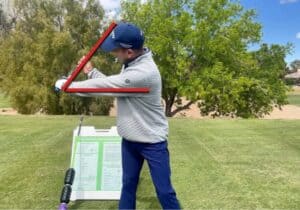
Film a few normal swings from face-on with the phone safely outside the swing area. Watch the final part of the backswing in slow motion.
The arms and chest do not have to stop at precisely the same instant. Some continued arm and club movement is normal. Look instead for a pronounced late collapse: your hands pull noticeably closer to your head as your elbows fold but your torso has made little additional turn.
That can make the swing look impressively long without adding a useful amount of body motion. It also changes how much the arms need to extend again to reach the ball.
Rehearse finishing the backswing just before that extra fold. Keep your normal turn, let your trail elbow bend naturally and allow the wrists to hinge. Do not lock either arm straight or pin your elbows against your ribs.
Then hit a few short, comfortable shots. The question is whether removing that final fold makes contact easier to repeat. My earlier look at compact versus long backswings explains why the answer will not be the same for every golfer.
3. You have to tip or sway to finish going back
Your body should move during a golf swing. Pressure shifts between your feet, your hips turn and your head may move. Trying to freeze all of that creates its own problems.
What deserves attention is a late movement that appears only when you reach for more length. Perhaps you tip toward the ball, drift farther over the outside of your trail foot or straighten abruptly to get the club farther behind you.
Make a slow rehearsal and stop just before that movement begins. Can you stay comfortably supported by your feet without taking a recovery step? Compare that position with your usual finish to the backswing.
If you are stable until the final reach, experiment with ending the motion earlier. Let your hips turn comfortably. Restricting them to manufacture more stretch is not the goal.
A balance change can have other causes including your setup. Treat this as a clue to test, not proof that backswing length explains every mishit.
Keep the turn and test the shorter finish
Use an 8-iron, a familiar target and a level lie. Hit several shots with your normal swing and then make the small reduction suggested by the sign you noticed. Keep your intended effort similar so you are not comparing a full shot with a gentle pitch.
Watch contact, starting direction and carry. MyGolfSpy’s guide to reading ball flight during practice can help you describe the result without guessing at the cause.
Film the shorter version, too. What feels dramatically shorter may look only slightly different. Judge the change over more than one practice session, especially before taking it to a longer club.
If contact becomes more predictable and the useful distance remains, you have a reason to keep working with that length. If you lose carry, feel cramped or start snatching the club down, reconsider the adjustment. The right stopping point gives you room to swing through the ball without having to recover what you lost going back.







Leave A Reply