


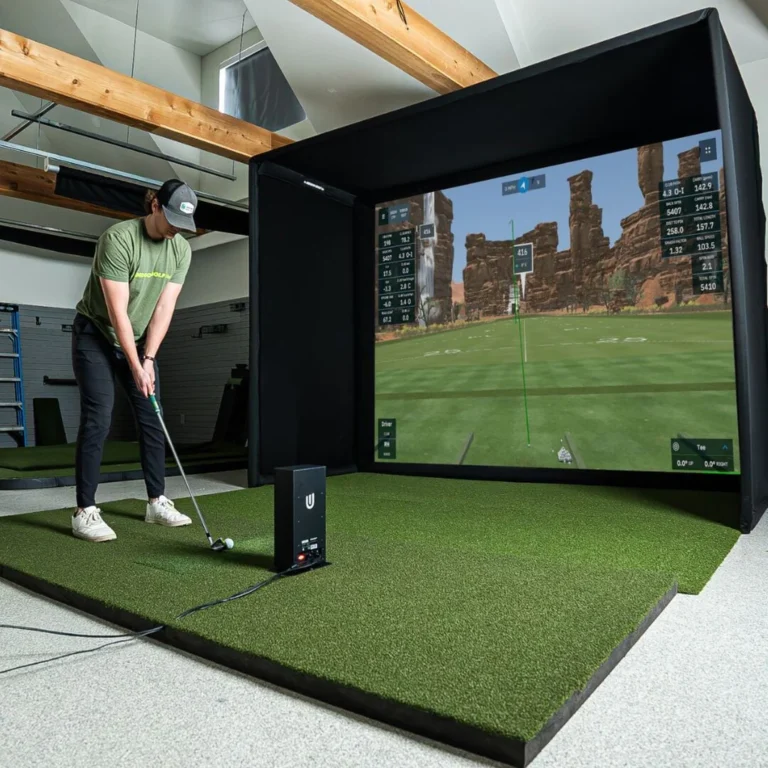
Indoor golf has exploded. Simulators at home, golf lounges in cities, year-round practice bays. But here’s the problem: most golfers who practice indoors aren’t actually improving their ball striking. They’re just hitting balls into a screen and hoping the numbers get better.
Indoor practice requires a different approach than range work. The feedback is different. The environment is different. And if you’re not intentional about how you use that indoor time, you’ll groove bad habits that show up when you finally get outside.
Why indoor practice actually changes your swing
The flat surface problem
Every indoor facility has a perfectly flat mat. No uphill lies, no downhill lies, no ball above or below your feet. Your body adapts to this consistency. Then you get on a real course with uneven terrain and your contact falls apart.
The mat also lies to you. A shot hit two inches behind the ball still feels decent because the club bounces off the firm surface. On grass, that same swing takes a divot the size of a dinner plate and the ball goes nowhere.
Visual feedback disappears
On a range, you watch ball flight. You see the curve, the trajectory, the landing pattern. Indoors, you’re staring at numbers on a screen: launch angle, spin rate, carry distance. Those numbers matter but they don’t tell you everything about your swing.
The distance trap
Indoor simulators make it too easy to obsess over distance. You hit your 7-iron, see 165 yards, and then try to squeeze out 170. You start swinging harder, not better. Ball striking suffers because you’re chasing numbers instead of quality contact.
The data that actually improves contact
Focus on three specific metrics when practicing indoors.
This is the ratio of ball speed to club speed. A 7-iron with perfect contact produces a smash factor around 1.33 to 1.38. If you’re consistently below 1.30, you’re not hitting the center of the face. This number doesn’t lie about contact quality.
Consistency of launch angle
Hit 10 7-irons. If your launch angles range from 14 to 22 degrees, your contact is all over the face. Thin shots launch low, heavy shots launch high. Tight launch angle dispersion means you’re finding the sweet spot repeatedly.
Spin rate variance
Similar to launch angle, spin rate reveals contact quality. Your 7-iron might spin around 6,500 rpm with pure contact. If your shots vary from 5,000 to 8,000, you’re hitting it everywhere but the center.
Consistent spin means consistent strike.

What indoor practice reveals about your swing
Simulators expose specific ball striking issues that are easy to miss outdoors.
The thin shot pattern
If your shots consistently launch lower than expected with less spin, you’re catching the ball thin. The simulator shows this immediately. On grass, you might not notice because thin shots still travel decent distances.
Inconsistent low point
Watch where your club contacts the mat. Does it hit the same spot every time or does your low point wander? Indoor mats show scuff marks. If those marks are scattered across a six-inch area, your low point control needs work.
Face contact patterns
Many simulators show exactly where on the face you made contact: toe hits, heel hits, high on the face, low on the face. This feedback is gold. If you’re consistently missing the center in one direction, you know exactly what to fix.
How to actually improve contact indoors
Follow a systematic approach to make indoor practice translate to better ball striking.
Start every session with alignment
Indoor facilities don’t have natural targets like range flags. Set up alignment sticks every single session: one along your toe line, one pointing at your target. Poor alignment creates compensations that destroy contact quality. Another highly recommended alignment tool is the Stance Caddy, a tool that makes alignment and ball positioning easy. It’s one of the most complete alignment trainers available. It covers ball position, stance width and aim all in one compact system.
Use impact tape or foot spray
Put impact tape on your clubface or spray it with foot powder. Hit five shots, check the marks. Are you finding the center? If not, make adjustments before you groove a bad pattern. The simulator might say the shot was decent but the tape doesn’t lie.
Practice with tempo, not power
Indoor environments encourage you to swing hard because there’s no consequence for a bad shot: no lost ball, no hazard, no embarrassment. Fight this urge. Make smooth, controlled swings at 80 percent effort. Focus on center contact, not maximum distance.
Hit different clubs to the same distance
This drill forces quality contact. For example, try to hit your 8-iron, 7-iron and 6-iron all to 150 yards. The 8-iron requires a full swing while the 6 requires a controlled swing. If you can’t hit all three to the same distance with consistent contact, you’re not controlling your strike.
Record your swing from down the line
Most indoor facilities have space to set up your phone. Record your swing from the down-the-line angle. Watch your low point. Is your head staying steady? Are you maintaining your spine angle? Video reveals the swing flaws that create inconsistent contact.

Making indoor practice transfer outside
The simulator gives you feedback. The course tells you if that feedback matters.
If possible, take your indoor improvements outside regularly. Hit balls on grass at least once a month if the weather allows. Does your improved smash factor hold up on real turf? Are you still finding the center when the lie isn’t perfect?
Use indoor practice to build fundamentals and then test those fundamentals in real conditions. The goal isn’t perfect simulator numbers. It’s better contact when it counts. If your indoor work helps you hit more greens and shoot lower scores outside, you’re using that screen time correctly.









Tiger Irons
10 months ago
Great article. I’ve experienced that shocking disparity between indoor sim performance and shanks at the grass range. This gives me a reason to continue paying for the indoor sim.