


I’ve spent a lot of time digging into our driver data and there’s something I always find a little funny. A golfer will tell you they hit their driver 250. I know it’s just an average and I get why we all do it.
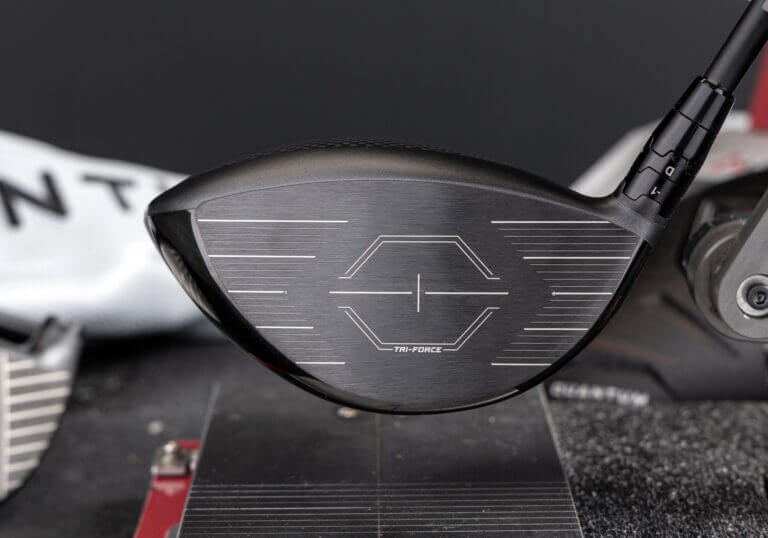
But an average is built from every swing, not just the good ones, and most swings don’t find the sweet spot. I wanted to know what’s inside that 250 so I ran some deeper studies on our data: more than 105,000 clean driver shots from 139 of our testers. Only 34 percent of a typical tester’s strikes landed within 10 mm (.39 of an inch) of the center of the face and 69 percent of testers sit significantly more than 5 mm (.2 of an inch) off center on average.
So your driver distance isn’t one number. It’s a spread of outcomes, most of them are misses. The question is what those misses cost.
What the normal miss costs
When I compared each tester’s most frequent miss zone with their own sweet-spot strikes at the same club speed, it cost a median of 5.4 yards of carry (middle half of testers: 3.8 to 7.3). Where you miss decides how much you lose and how you lose it.
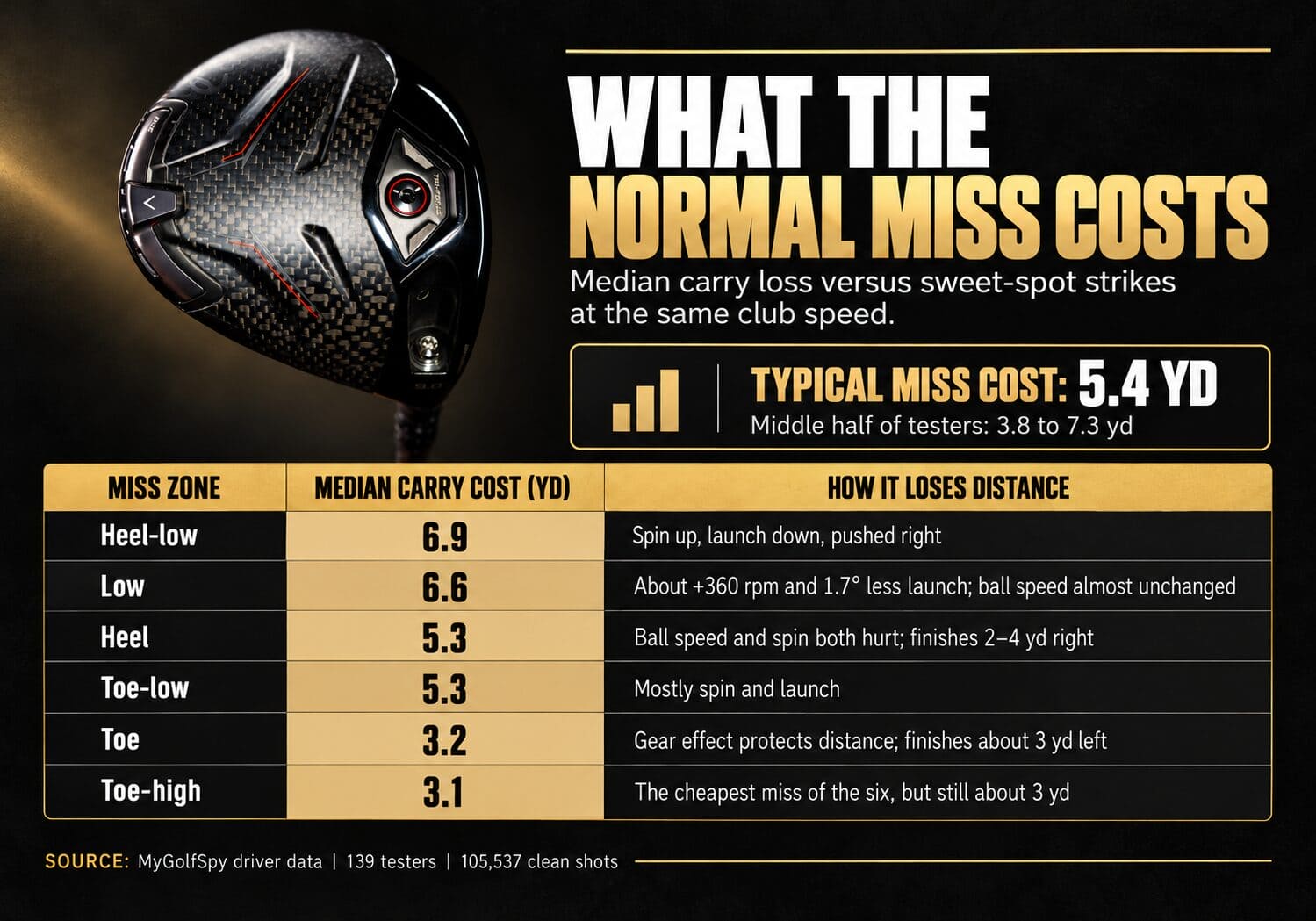
A quick word on gear effect since it shows up in that table. When you strike the ball away from the center of the face, the clubhead twists slightly at impact and that twist changes the spin on the ball. Toe strikes add draw spin which is why those misses finish left. High strikes take spin off the ball and low strikes add it which is part of why height on the face matters so much.
The one that surprised me is that dead center isn’t the longest spot. Peak carry sits about 7 mm (.28 of an inch) toward the toe and 5.5 mm (.22 of an inch) high, worth roughly two yards over a center strike. A high strike loses 3.8 mph of ball speed but lower spin and higher launch win most of it back.
The bigger problem is scatter, not bias
Say your typical strike lands a little toward the toe. That’s your average miss and it’s the thing most of us would try to fix. In our data, that average miss costs the median tester only 1.7 yards of carry.
The bigger cost is the swings that don’t land on that typical spot at all: the ones that come off the heel or low on the face. They add another 4.6 yards. Together, that puts the median tester 6.4 yards short of what they’d carry if every swing hit the longest-carry spot on the face. Moving the average strike to dead center would gain the median tester just 0.3 of a yard (one foot).
The bottom line: the more consistent your strike, the better, even if that strike misses the center slightly. A repeatable miss costs you less than strikes that wander all over the face. No one hits the best spot every time, so you won’t get all 6.4 yards back but it shows where the yards are.
Why this matters when you pick a driver
Most driver comparisons are built on a golfer’s best swings which is exactly the shot they rarely hit. If your strikes spread across the face, the more useful question is what a driver gives up when you miss, and where. What I take from the data is that the cost depends on where the miss lands: a low strike costs about 6.6 yards, a toe-high strike about 3.1.
That starts with knowing your own pattern. A tester’s average strike location is very stable (r = 0.95 heel-to-toe across random halves of their drivers) so a measured pattern is worth trusting. But the zone label itself repeats from year to year only 47 percent of the time so treat “toe-low” as a tendency. It’s not an identity.
When you test drivers, get your impact pattern measured, look at the whole spread rather than the average, and pay attention to the shots that missed center, not just the best one.
A note on the data
Everything here comes from eight driver tests (2016, 2017, 2020, 2021, 2023–2026): 139 testers, 105,537 clean shots. Our testers are skilled and lean toward toe strikes so these numbers describe our pool, not all golfers. The average strike sits about 3 mm (.1 of an inch) more toe-low in 2025–26 than in 2016–20 which could reflect tee protocol or firmware. Carry totals are GC Quad-modeled, with roll, and were measured indoors.








Dave
2 hours ago
Since most of my driver hits are off center, I’m really not losing much at all. I gain on the rare center strike and say, hmm, where’d that come from?