


The golf ball rollback has been delayed but it has not disappeared.
The USGA and R&A recently moved away from their original plan to introduce the new ball standard for elite competition in 2028 before extending it to everyone else in 2030. Instead, the governing bodies are targeting a single implementation date in 2030 so we would all be jumping into the brave new world together. They released a formal notice to manufacturers this week which is open for comment until Oct. 21.
If you ask me, this is a huge headache for not nearly enough of a benefit.
I understand the argument behind the rollback. Professional golfers hit the ball incredible distances. We just had a guy average 331 yards per tee shot, setting the all-time distance record on the PGA Tour. Courses have been lengthened as a reaction (which I think is ridiculous), bunkers have been moved and classic architecture has occasionally been overwhelmed by equipment advances and increasingly athletic players.
But making the golf ball slightly shorter for everyone remains an unnecessarily blunt solution to a problem created by a minuscule percentage of golfers.
And, ultimately, if you give players and manufacturers a new set of guidelines, they are eventually going to figure out a way to optimize every club and ball to maximize their distance and forgiveness. It just seems like we are doing a hell of a lot for very little gain and we’ll end up in a similar place not long from now.
I also get that recreational players may not see that much of an effect with the rollback but they shouldn’t be a part of this conversation in the first place. When is the last time you played a course and thought, “this place is too short for 14-handicaps”?
They aren’t flying fairway bunkers from 315 yards or reducing 500-yard par-4s to a pitch ‘n’ putt. Weekend hackers are just trying to carry the ball 220 yards, reach a par-4 in regulation and finish before sunset.
And it’s frustrating because I think there are two alternatives that would accomplish a lot of what the ball rollback is trying to hit.
If professional golf wants to rein in its longest players and bring more skill back into the game, why not go with two alternatives that are cheaper, simpler and considerably more interesting: restrict pros to 10 clubs and make them use shorter tees?
One side attacks specialization. The other would directly address driving distance.
And, if it were up to me, neither would punish the ordinary golfer.
Give professional golfers only 10 clubs
The 14-club limit has existed for nearly 90 years but there is nothing sacred, scientific or meaningful about that particular number.
The governing bodies chose it to put out a fire. At the 1935 U.S. Open, pros were carrying an average of 18 clubs. Lawson Little, one of the best amateurs of his generation, reportedly carried as many as 30 (would hate to be his caddie).
It was getting out of hand (literally) so they put a stop to the nonsense.
But the number 14? It’s only gospel because a nearly century-old rule says it is.
Tour players now have equipment built for remarkably specific purposes. They carry multiple wedges separated by narrow loft gaps, driving irons designed for certain courses and high-lofted fairway woods that land like the proverbial butterfly with sore feet.
That is impressive … but it also removes decisions.
They have a club for virtually every distance. There is less need to take something off a longer club, hit a shorter club harder or alter trajectory. The equipment menu is comprehensive enough to provide a highly specialized answer for nearly every question and you get a lot of pros that don’t play an imaginative brand of golf. It’s robotic.
Reducing the professional limit to 10 clubs would change that, in my opinion.
Players would have to construct their bags specifically for each course. Do you need four wedges at a short, demanding venue or would you rather preserve your options near the top of the bag? Do you carry a 3-wood for two reachable par-5s or use that spot on another iron to close a troublesome yardage gap?
Those decisions would become an integral part of the tournament. We would all be talking about it at length. Manufacturers would get more of the spotlight, not less.
Broadcasters could explain why a player chose a 7-wood over a 3-iron or why someone left a gap between his 6- and 8-irons. When a golfer had a troublesome yardage, we would watch him improvise rather than select the perfectly calibrated option.
The best players would still win. I would argue the top players would win more. They would simply have to demonstrate a broader range of skills along the way.
This rule should apply only to elite competition. Recreational golfers should be allowed to carry 14 clubs (or more, for all I care).
There is no reason to make golf harder for someone who plays twice per month. If a 15th, 16th or 17th club helps a 15-handicapper enjoy the round, let him carry it.
Professional golf should be asked to become more challenging but in an interesting way like this. Recreational golf should be encouraged to become more enjoyable.
Those are not contradictory positions to me.
Lower the tee and watch what happens
The 10-club rule would improve strategy but it likely would have no effect on driving distance. Virtually every player would keep a driver in the bag. After all, it has become the most important club in pro golf. Even Tiger admitted as much.
That is where tee height comes into the equation.
Go ahead and laugh. I’m being serious.
Nick Faldo recently proposed making professionals use one-inch tees, an idea Rory McIlroy said he would support testing (Faldo also endorsed reducing the number of clubs available to PGA Tour players).
A modern driver is designed to launch the ball high with relatively low spin. Teeing the ball high makes it easier to strike the upper portion of the face and hit upward through impact, helping players create the launch conditions needed to maximize distance.
Lower the ball and that becomes substantially more difficult. How do I know? We tested it!
In our tee height testing, shots struck from a 1.5-inch tee carried an average of 14.19 yards farther than those struck from a half-inch tee. The total distance difference was 14.66 yards while the lower tee produced roughly 326 additional revolutions per minute of spin.

That was one test involving a particular driver, ball and group of golfers, so we shouldn’t assume every Tour player would immediately lose exactly 14 yards. More extensive testing would be required.
The potential is obvious, though.
A lower tee would make center contact more difficult and reduce the ability to launch the ball with minimal spin. It could bring back the low, controlled drive and force players to decide when maximizing speed is actually worth the risk.
At the moment, the driver is the safest club in the bag for pros. This would make it a little less safe.
The current equipment rules permit tees as long as four inches. For designated professional events, tournaments could supply one-inch tees—more palatable than going straight to half-inch tees—on every tee box and require players to use them. That would be extraordinarily cheap and easy to trial.
Try it at a fall event. Collect the launch-monitor data. Ask players how it affected strike location, curvature, carry distance and club selection.
Baseball does this kind of minor league experimentation all the time. It’s how we ended up with the pitch clock (which was a massive success).
If it doesn’t work, abandon it. Golf would have lost virtually nothing, right?
That is considerably more appealing than forcing manufacturers to redesign entire product lines for what seems like a nebulous benefit.
Make professional golf different (but don’t make recreational golf worse)
The immediate objection will be bifurcation. There’s that word again.
Golf has traditionally valued the concept that professionals and amateurs play under substantially the same rules. You can buy the same ball, play the same equipment and compare your score on the same course. That was the value being protected with the ball rollback plan.
I appreciate that sentiment but the professional game is already wildly different than the recreational game. You could argue they have never been further apart.
Tour players compete on perfectly manicured courses with grandstands, TIO (temporary immovable obstruction) relief, model local rules, spotters, rules referees, coaches and equipment technicians. Their drivers are optimized to fractions of a degree. Go to a pro golf event and it’s clear they are basically playing a different sport compared to a weekend hacker.
Pretending their version of golf is identical to a Saturday morning foursome is increasingly ridiculous.
And if bifurcation is unacceptable, why should ordinary golfers eventually be required to use a shorter ball because professionals hit it too far? That is still imposing a solution designed for elite golf upon millions of people who didn’t create the problem.
A 10-club limit and shorter tees would produce a cleaner separation. Some will call it gimmicky but it’s only weird because it goes against long-held arbitrary standards.
Let professionals keep the current golf ball but make them think harder and work more creatively. Reduce their driving distance by changing how high they can tee the ball, not by changing the ball itself.
Meanwhile, leave recreational golfers alone. Let them use normal tees, the current ball and as many clubs as they reasonably want to carry.
Where is the cutoff? I would say if you are making a paycheck, these rules apply. If you aren’t, they don’t.
Am I crazy? Let me know what you think in the comments.
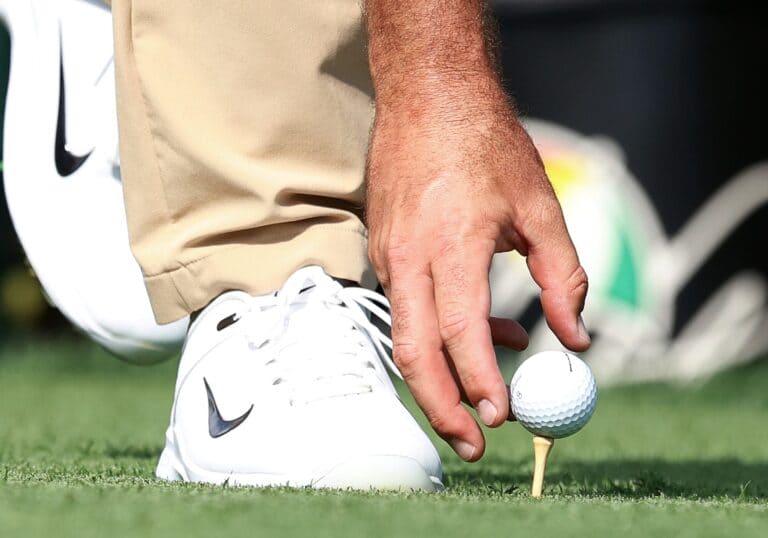
Top Photo Caption: Scottie Scheffler puts a tee in the ground at the Arnold Palmer Invitational. (GETTY IMAGES/Brian Spurlock)



Mike
6 seconds ago
Thank the blueblood idiots at the usga for this mess. They stood around w/ their heads up their a**es for years on this subject, then realized it was an issue. Even Tiger endorsed bifurcation yet they discounted that simple solution. Here’s a few solutions; throw a few pot bunkers out there on some holes so hitting driver isn’t an automatic choice. Then cut the fairways at a height that matches many public courses.
But honestly, I DONT’T CARE what the winning score is in any event. In EVERY SINGLE ONE, the person w/ the fewest strokes is the winner. And I enjoy seeing the pros make birdies & eagles. Golf is the ONLY sport where in the major events, the try to artificially keep scores worse. Do they narrow the goalposts at the Super Bowl? Push back the fences at the World Series? Raise the rims at the NBA finals? NO, NO & NO. Only the golf governing bodies do this nonsense. The back 9 at the Masters used to be fun to watch w/ potential eagles on 13 & 15. Now, virtually no one eagles these holes.